
Dr. Kate Kresge
Dr. Holly Lucille
Dr. Lara Zakaria
Dr. Jessica Christie
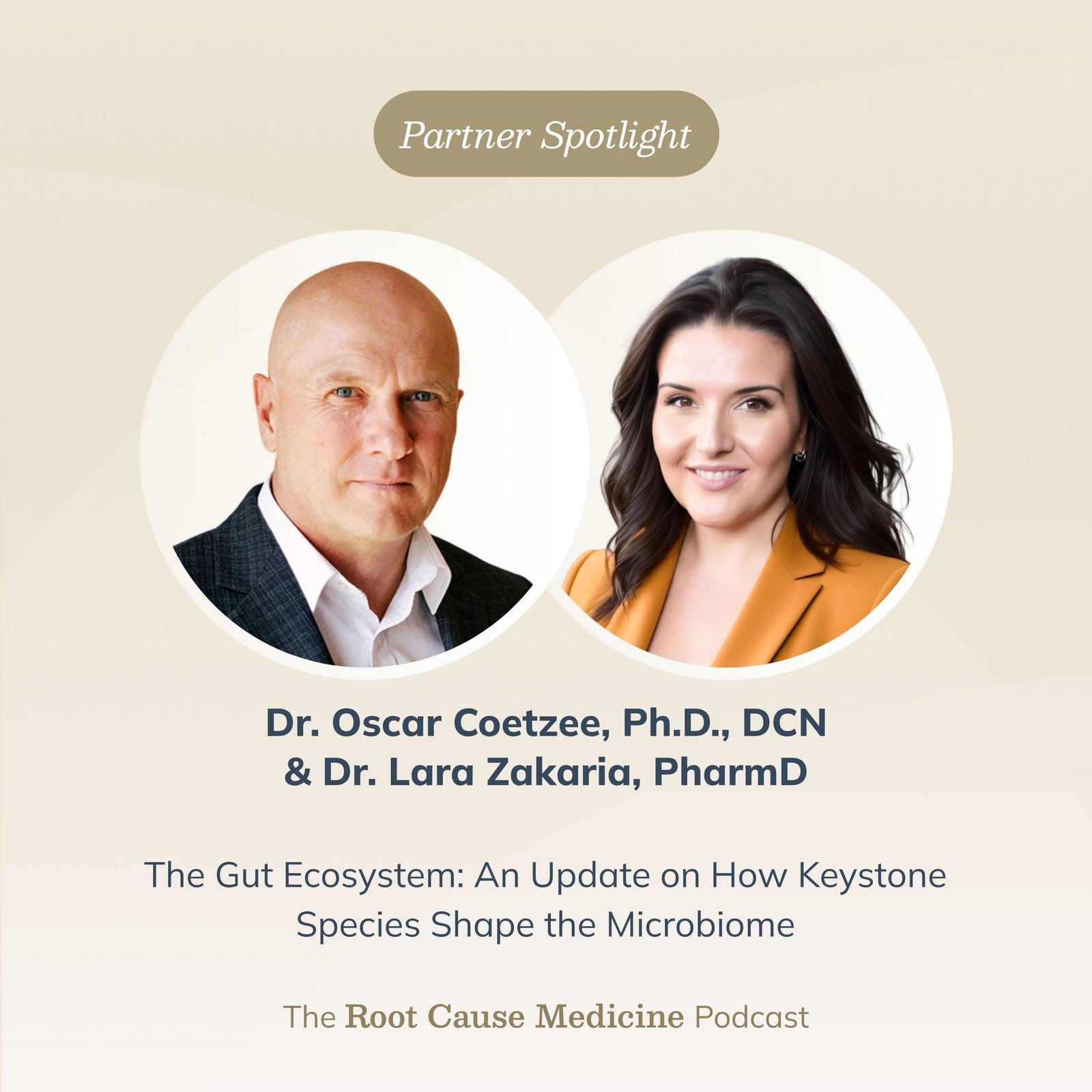
The Gut Ecosystem: An Update on How Keystone Species Shape the Microbiome


Dr. Oscar Coetzee joins Dr Lara Zakaria on the Root Cause Medicine Podcast to discuss emerging research on keystone commensal organisms and how microbial communities interact within the gut ecosystem.
The conversation focuses on organisms including Akkermansia muciniphila, Faecalibacterium prausnitzii, Roseburia, Bifidobacterium longum, and Bifidobacterium adolescentis. Rather than viewing individual microbes in isolation, Dr. Coetzee describes an ecosystem model centered on cross-feeding, short-chain fatty acid production, and the intestinal environment.
The episode also notes an important context: research on next-generation commensals is still developing, meaning findings from mechanistic studies, case reports, and early clinical research offer initial insights that complement rather than replace evidence from larger randomized controlled trials. (Jan 2024) (Kern 2026)
Clinical takeaways
- Keystone organisms are discussed as members of an interconnected ecosystem. The episode explores how organisms can produce metabolites or modify environmental conditions that may influence other members of the microbial community. (Belzer 2017) (Fusco 2023)
- Short-chain fatty acids are a major theme. Akkermansia, Faecalibacterium, and Roseburia are discussed in relation to acetate, propionate, and butyrate production and their potential roles within the intestinal environment. (Martin-Gallausiaux 2021) (Tingler 2025)
- Clinical evidence remains emerging. Dr. Coetzee describes early clinical observations and studies in progress, while the conversation acknowledges the need for additional published research, including controlled trials, before broader clinical conclusions can be drawn. (Jan 2024) (Kern 2026)
Guest: Oscar Coetzee, PhD, DCN
Dr. Oscar Coetzee is Vice President of Clinical Education and Practitioner Support at Designs for Health. In the episode, he discusses his work in nutrition and microbiome research and his interest in next-generation commensal organisms.
His discussion centers on moving beyond a single-organism view of probiotics toward understanding microbial communities, cross-feeding, and the environment in which commensal organisms coexist.
Clinician FAQ
1. What are keystone commensal organisms?
They are microbes discussed for their potentially important roles within the broader gut ecosystem. (Rios Garza 2026)
The episode focuses on how selected commensals interact with other organisms and their environment rather than evaluating them solely by abundance. (Banerjee 2018)
2. Which organisms are discussed?
The main organisms include Akkermansia muciniphila, Faecalibacterium prausnitzii, Roseburia, Bifidobacterium longum, and Bifidobacterium adolescentis.
The conversation also discusses Anaerostipes caccae separately in the context of butyrate production and microbial cross-feeding. (Belzer 2017)
3. What is microbial cross-feeding?
Cross-feeding describes how metabolites produced by one organism can serve as substrates or influence conditions for another. (Culp 2023) (Louis 2017)
The episode uses this concept to explain why microbial communities may be more informative than considering individual organisms in isolation. (Culp 2023)
4. Why are short-chain fatty acids discussed?
They are microbial metabolites that form part of the communication between gut microbes and their environment. (Martin-Gallausiaux 2021)
The conversation highlights acetate, propionate, and butyrate while exploring how different commensal organisms contribute to their production. (Martin-Gallausiaux 2021)
5. How established is the clinical evidence?
Research on these next-generation commensals is still evolving. (Jan 2024) (Kern 2026)
The guest describes case observations, prospective studies, and additional research underway. These early findings can generate hypotheses, but they do not establish that a specific probiotic combination prevents or treats disease.
Timestamps / key moments
00:00:00 Introducing keystone commensal organisms
00:05:35 Why newer technology matters for anaerobic microbes
00:08:09 Moving beyond probiotic quantity and individual strains
00:13:32 Microbial compensation and ecosystem dynamics
00:18:00 Keystone organisms and emerging clinical observations
00:21:28 Akkermansia and microbial metabolites
00:24:08 Faecalibacterium prausnitzii and butyrate
00:30:49 Roseburia and the anaerobic environment
00:32:24 Bifidobacterium species in the microbial community
00:35:52 Anaerostipes caccae and cross-feeding
00:39:58 Supporting the microbial ecosystem
00:44:18 Current research and evidence limitations
00:48:02 Clinical considerations and unanswered questions
01:02:15 Future research and closing discussion
Want to learn more about microbiome science?
This episode highlights an evolving way of thinking about the microbiome: not simply as a collection of individual organisms, but as an ecosystem shaped by microbial interactions, metabolites, available substrates, and environmental conditions.
For additional practitioner education on supplement quality and clinical decision-making, visit Fullscript Academy.
Disclaimer
The views expressed on this podcast are those of the host and guest and do not necessarily reflect those of Fullscript or affiliated organizations.
This episode is for informational and educational purposes only and is not medical advice. Research on next-generation commensal organisms and related probiotic formulations is evolving, and emerging findings should be interpreted in the context of the strength and limitations of the available evidence.
References
- Banerjee, S., Schlaeppi, K., & van der Heijden, M. G. A. (2018). Keystone taxa as drivers of microbiome structure and functioning. Nature Reviews Microbiology, 16(9), 567–576. https://doi.org/10.1038/s41579-018-0024-1
- Belzer, C., Chia, L. W., Aalvink, S., Chamlagain, B., Piironen, V., Knol, J., & de Vos, W. M. (2017). Microbial metabolic networks at the mucus layer lead to diet-independent butyrate and vitamin B12 production by intestinal symbionts. mBio, 8(5), e00770-17. https://doi.org/10.1128/mBio.00770-17
- Culp, E. J., & Goodman, A. L. (2023). Cross-feeding in the gut microbiome: Ecology and mechanisms. Cell Host & Microbe, 31(4), 485–499. https://doi.org/10.1016/j.chom.2023.03.016
- Fusco, W., Lorenzo, M. B., Cintoni, M., Porcari, S., Rinninella, E., Kaitsas, F., Lener, E., Mele, M. C., Gasbarrini, A., Collado, M. C., Cammarota, G., & Ianiro, G. (2023). Short-chain fatty-acid-producing bacteria: Key components of the human gut microbiota. Nutrients, 15(9), 2211. https://doi.org/10.3390/nu15092211
- Jan, T., Negi, R., Sharma, B., Kumar, S., Singh, S., Rai, A. K., Shreaz, S., Rustagi, S., Chaudhary, N., Kaur, T., Kour, D., Sheikh, M. A., Kumar, K., Yadav, A. N., & Ahmed, N. (2024). Next generation probiotics for human health: An emerging perspective. Heliyon, 10(16), e35980. https://doi.org/10.1016/j.heliyon.2024.e35980
- Kern, L., Tofield, A., Frame, J., & Elinav, E. (2026). Next-generation probiotics: An outlook into current applications and future developments. Nature Reviews Microbiology, 24(8), 539–558. https://doi.org/10.1038/s41579-026-01311-0
- Louis, P., & Flint, H. J. (2017). Formation of propionate and butyrate by the human colonic microbiota. Environmental Microbiology, 19(1), 29–41. https://doi.org/10.1111/1462-2920.13589
- Martin-Gallausiaux, C., Marinelli, L., Blottière, H. M., Larraufie, P., & Lapaque, N. (2021). SCFA: Mechanisms and functional importance in the gut. Proceedings of the Nutrition Society, 80(1), 37–49. https://doi.org/10.1017/S0029665120006916
- Rios Garza, D., Gonze, D., & Faust, K. (2026). Keystone concept revisited: Insights into microbial community dynamics and control. Nature Reviews Microbiology, 24(5), 359–371. https://doi.org/10.1038/s41579-025-01266-8
- Tingler, A. M., & Engevik, M. A. (2025). Breaking down barriers: Is intestinal mucus degradation by Akkermansia muciniphila beneficial or harmful? Infection and Immunity, 93(9), e0050324. https://doi.org/10.1128/iai.00503-24