
Dr. Kate Kresge
Dr. Holly Lucille
Dr. Lara Zakaria
Dr. Jessica Christie
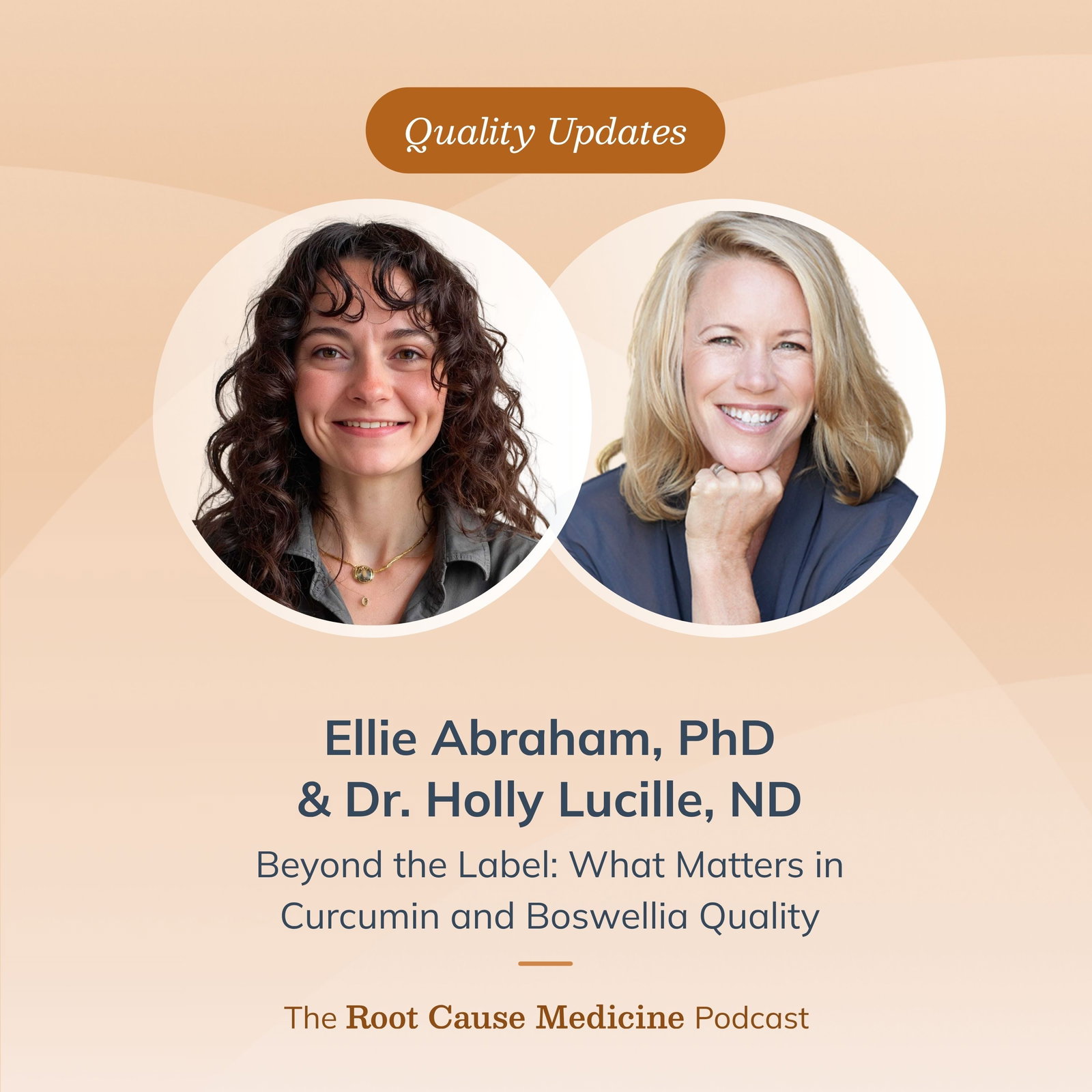
Beyond the Label: What Matters in Curcumin and Boswellia Quality


Dr. Holly Lucille, ND, is joined by Ellie Abraham, PhD, to explain why two curcumin or Boswellia supplements may not be equivalent, even when the front of the label looks similar. The conversation covers boswellic acid standardization, AKBA, curcumin delivery systems, piperine, botanical sourcing, finished-product testing, certificates of analysis, and supply-chain controls. Research supports meaningful variation in Boswellia composition and curcumin formulations, making the specific extract and formulation relevant when interpreting product labels and published evidence. (Meins 2016) (Mimica 2022)
Clinical Takeaways
- “Boswellic acids” describes a group of compounds. Boswellia preparations can contain different proportions of individual boswellic acids, including AKBA, KBA, and alpha- and beta-boswellic acids. Products with similar total boswellic acid claims therefore may not have identical chemical profiles. (Mannino 2016) (Meins 2016)
- Curcumin formulation matters. Conventional oral curcumin has low bioavailability, and formulations including phytosomes, liposomes, micelles, and piperine combinations have been studied as strategies to alter absorption. However, different formulations should not automatically be treated as interchangeable because comparative pharmacokinetic results vary. (Hegde 2023) (Fança-Berthon 2021)
- Standardization provides more information than an ingredient name alone. Botanical composition can vary with species, growing conditions, extraction, processing, and other supply-chain factors. Standardization and appropriate quality controls can help establish more consistent composition. (Ribnicky 2008) (Sarma 2021)
- Potency is only one part of quality. Botanical quality also involves identity, purity, contaminants, adulteration, and finished-product verification. Published investigations have identified labeling and authenticity concerns in both Boswellia and turmeric/curcumin products. (Meins 2016) (You 2022)
- Quality does not equal clinical fit. A well-characterized supplement still needs to be considered in the context of the individual patient, including the formulation, dose, supporting evidence, medication use, and potential botanical-drug interactions. (van Breemen 2008)
Guest: Ellie Abraham, PhD
Ellie Abraham has a PhD in plant biology, with research focused on developing analytical methods for testing finished botanical products. Her background includes botanical chemistry, finished-product testing, standardization, and dietary supplement quality. In this episode, she explains how practitioners can look beyond an ingredient name to assess what a curcumin or Boswellia product is actually formulated to deliver.
These five questions best match the broad topics addressed in the episode, particularly searches around Boswellia standardization, AKBA, curcumin absorption, piperine, and supplement quality. Exact search volume is not publicly available from a standard web search. These topics are also represented in published research on botanical quality and curcumin formulation.
Clinician FAQ
1. Are all Boswellia supplements the same?
No. Boswellia products may differ in species, extract composition, total boswellic acid content, and concentrations of individual boswellic acids such as AKBA and KBA. A survey of commercial Boswellia supplements found substantial variation in composition and label compliance. (Meins 2016)
2. What does boswellic acid standardization mean?
It indicates that an extract is standardized to a stated amount of boswellic acids or, in some products, a particular constituent such as AKBA. Boswellia contains multiple boswellic acids, and their relative concentrations can vary by species and extract. (Mannino 2016) (Lauß 2024)
3. Why is AKBA listed separately on some Boswellia products?
AKBA, or 3-O-acetyl-11-keto-β-boswellic acid, is one individual boswellic acid that has received substantial pharmacologic research attention. Calling it out separately provides more specific compositional information than reporting total boswellic acids alone. (Ammon 2016)
4. Why do curcumin supplements use phytosomes, liposomes, or piperine?
Conventional oral curcumin has limited bioavailability. Phospholipid complexes, liposomal and micellar systems, and co-administration with piperine are among the approaches studied to alter its absorption and pharmacokinetics. Results vary by formulation, so an “enhanced absorption” format does not by itself establish that two products are equivalent. (Mirzaei 2017) (Heidari 2023) (Mimica 2022)
5. How can practitioners assess curcumin and Boswellia supplement quality?
Look beyond the ingredient name. Relevant product information may include botanical identity, extract and standardization details, branded ingredients tied to specific research, contaminant and adulteration testing, finished-product verification, and manufacturer transparency. Published studies have documented variability and authenticity concerns in commercial Boswellia and turmeric products. (Meins 2016) (You 2022)
Timestamps / Key Moments
00:00:36 Why familiar botanical names do not make products equivalent
00:01:27 Understanding Boswellia and boswellic acid standardization
00:02:05 Total boswellic acids and individual compounds
00:03:47 Why the boswellic acid profile matters
00:05:40 Matching botanical extracts to the supporting evidence
00:06:09 Curcumin delivery methods and formulation differences
00:07:12 Phospholipid-based curcumin formulations
00:08:29 How piperine is used with curcumin
00:10:43 Finished-product testing and label claims
00:13:43 Heavy metals and synthetic curcumin concerns
00:14:09 Understanding California Proposition 65
00:16:40 Curcuminoid complexes and certificates of analysis
00:18:18 How supply-chain controls affect botanical composition
00:20:07 Why standardization matters from batch to batch
00:21:05 What practitioners can look for when reviewing products
00:22:40 Fullscript's approach to supplier and product quality review
Botanicals and Compounds Discussed
- Boswellia
- Boswellia extracts
- Boswellic acids
- AKBA (3-O-acetyl-11-keto-β-boswellic acid)
- Beta-boswellic acid
- Turmeric
- Curcumin
- Curcuminoids
- Piperine
- Phospholipids
Quality Methods and Documents Discussed
- Botanical standardization
- Finished-product testing
- Ingredient identity verification
- Potency testing
- Heavy-metal testing
- Adulteration screening
- Synthetic curcumin testing
- Certificates of analysis
- Branded ingredient documentation
- Raw-material sourcing
- Supply-chain controls
- Extraction methods
- Stability data
- Batch-to-batch consistency
- Supplier and brand vetting
Want to elevate your practice?
This episode is sponsored by Fullscript, a comprehensive care delivery platform designed to support whole-person, integrative healthcare. Fullscript allows clinicians to streamline supplement dispensing, lab ordering, and patient education in one centralized system. For practitioners, Fullscript provides access to professional-grade supplements and practitioner education while incorporating quality review processes for brands and products offered through its catalog. The goal is not to replace clinical judgment, but to help practitioners make thoughtful, individualized decisions with clearer product and quality information.
For more practitioner education on supplement quality and clinical decision-making, visit Fullscript Academy at academy.fullscript.com.
Disclaimer
The views expressed on this podcast are those of the host and guest and do not necessarily reflect those of Fullscript or affiliated organizations. This episode is for informational and educational purposes only and is not medical advice. Dietary supplements may cause side effects or interact with medications. Patients should consult a qualified healthcare professional before changing their healthcare routine.
References
- Ammon, H. P. T. (2016). Boswellic acids and their role in chronic inflammatory diseases. Advances in Experimental Medicine and Biology, 928, 291–327. https://pubmed.ncbi.nlm.nih.gov/27671822/
- Fança-Berthon, P., et al. (2021). Pharmacokinetics of a single dose of turmeric curcuminoids depends on formulation: Results of a human crossover study. The Journal of Nutrition, 151(7), 1802–1816. https://pubmed.ncbi.nlm.nih.gov/34363434/
- Hegde, M., Girisa, S., BharathwajChetty, B., Vishwa, R., & Kunnumakkara, A. B. (2023). Curcumin formulations for better bioavailability: What we learned from clinical trials thus far? ACS Omega, 8(12), 10713–10746. https://pubmed.ncbi.nlm.nih.gov/37008131/
- Heidari, H., Bagherniya, M., Majeed, M., Sathyapalan, T., Jamialahmadi, T., & Sahebkar, A. (2023). Curcumin-piperine co-supplementation and human health: A comprehensive review of preclinical and clinical studies. Phytotherapy Research, 37(4), 1462–1487. https://pubmed.ncbi.nlm.nih.gov/36720711/
- Lauß, J., Kappacher, C., Isser, O., Huck, C. W., & Rainer, M. (2024). Species-specific quantification of bioactive boswellic acids in Boswellia resin using NIR spectroscopy, HPLC and multivariate data analysis. Spectrochimica Acta Part A: Molecular and Biomolecular Spectroscopy, 316, 124384. https://pubmed.ncbi.nlm.nih.gov/38701576/
- Mannino, G., Occhipinti, A., & Maffei, M. E. (2016). Quantitative determination of 3-O-acetyl-11-keto-β-boswellic acid (AKBA) and other boswellic acids in Boswellia sacra and Boswellia serrata. Molecules, 21(10), 1329. https://pubmed.ncbi.nlm.nih.gov/27782055/
- Meins, J., Artaria, C., Riva, A., Morazzoni, P., Schubert-Zsilavecz, M., & Abdel-Tawab, M. (2016). Survey on the quality of the top-selling European and American botanical dietary supplements containing boswellic acids. Planta Medica, 82(6), 573–579. https://pubmed.ncbi.nlm.nih.gov/27054914/
- Mimica, B., Bučević Popović, V., Banjari, I., Jeličić Kadić, A., & Puljak, L. (2022). Methods used for enhancing the bioavailability of oral curcumin in randomized controlled trials: A meta-research study. Pharmaceuticals, 15(8), 939. https://pubmed.ncbi.nlm.nih.gov/36015087/
- Mirzaei, H., Shakeri, A., Rashidi, B., Jalili, A., Banikazemi, Z., & Sahebkar, A. (2017). Phytosomal curcumin: A review of pharmacokinetic, experimental and clinical studies. Biomedicine & Pharmacotherapy, 85, 102–112. https://pubmed.ncbi.nlm.nih.gov/27930973/
- Ribnicky, D. M., et al. (2008). Evaluation of botanicals for improving human health. The American Journal of Clinical Nutrition, 87(2), 472S–475S. https://pubmed.ncbi.nlm.nih.gov/18258640/
- Sarma, N., Upton, R., Rose, U., Guo, D.-A., Marles, R., Khan, I., & Giancaspro, G. (2021). Pharmacopeial standards for the quality control of botanical dietary supplements in the United States. Journal of Dietary Supplements, 20(3), 485–504. https://pubmed.ncbi.nlm.nih.gov/34699287/
- van Breemen, R. B., Fong, H. H. S., & Farnsworth, N. R. (2008). Ensuring the safety of botanical dietary supplements. The American Journal of Clinical Nutrition, 87(2), 509S–513S. https://pubmed.ncbi.nlm.nih.gov/18258648/
- You, H., Gershon, H., Goren, F., Xue, F., Kantowski, T., & Monheit, L. (2022). Analytical strategies to determine the labelling accuracy and economically-motivated adulteration of “natural” dietary supplements in the marketplace: Turmeric case study. Food Chemistry, 370, 131007. https://pubmed.ncbi.nlm.nih.gov/34507212/