
Dr. Kate Kresge
Dr. Holly Lucille
Dr. Lara Zakaria
Dr. Jessica Christie
Inside Mosaic Diagnostics


Inside Mosaic Diagnostics: Clinical Applications of Organic Acids, Environmental, and Microbiome Testing
What Is Mosaic Diagnostics and How Are Its Lab Tests Used in Clinical Practice?
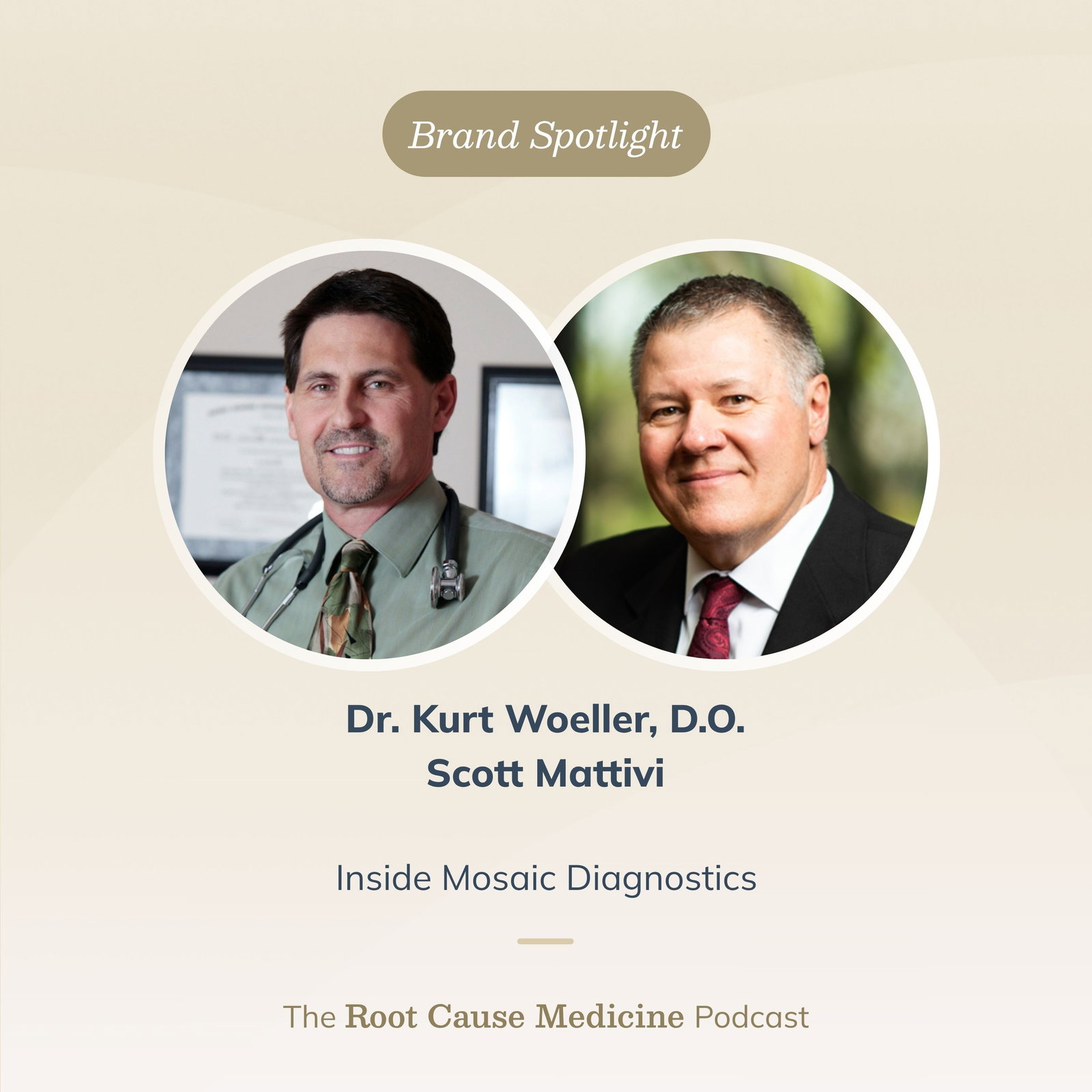
In this episode, Dr. Kate Kresge speaks with Mosaic Diagnostics CEO Scott Mattivi and Chief Medical Officer Dr. Kurt Woeller to explore how specialty laboratory testing is used in functional and integrative medicine. Mosaic Diagnostics offers tests such as organic acids, environmental exposure biomarkers, and microbiome assessments, which may help clinicians evaluate complex, multi-system presentations. These tools are typically used as part of a systems-based clinical framework, supporting pattern recognition rather than serving as standalone diagnostic tests. The discussion also explores how clinicians interpret multi-system lab data, the role of practitioner education, and how emerging technologies—such as AI-assisted tools—may support clinical efficiency and decision-making.
What Does Mosaic Diagnostics Test For?
Mosaic Diagnostics provides specialty lab testing commonly used in integrative and functional medicine, including:
- Organic acids testing (OAT)
- Environmental toxin and mycotoxin testing
- Microbiome and gastrointestinal assessments
- Metabolic and immune-related biomarkers
These tests are designed to provide insight into biochemical pathways, microbial activity, and environmental exposures. Results are generally interpreted alongside clinical history, symptoms, and conventional labs to support individualized care.
Key Clinical Insights
What Is Organic Acids Testing (OAT)?
Organic acids testing evaluates urinary metabolites involved in intermediary metabolism. It may provide insight into:
- Mitochondrial function
- Nutrient metabolism (e.g., B vitamins, amino acids)
- Oxidative stress patterns
- Microbial activity
When interpreted within clinical context, OAT may support identification of metabolic patterns and inform clinical hypotheses (Gallagher, 2018).
What Does Environmental Toxin Testing Measure?
Environmental exposure testing evaluates biomarkers associated with compounds such as:
- Mycotoxins
- Heavy metals (in some panels)
- Industrial chemicals
These tests may help characterize exposure patterns, though interpretation can be complex due to variability in exposure timing, metabolism, and elimination. Clinical relevance should be assessed cautiously and within the broader evidence base (Warth, 2013; Owolabi, 2024).
How Are Specialty Lab Tests Used in Functional Medicine?
Specialty lab testing is often used to support systems-based clinical reasoning, including:
- Identifying patterns across metabolic, immune, and gastrointestinal systems
- Generating clinical hypotheses
- Guiding further testing or interventions
Importantly, these tests are adjunctive tools and are most useful when interpreted alongside clinical presentation and other laboratory data (MedlinePlus, 2023).
Clinical Takeaways
- Organic acids testing may offer a systems-level view of metabolism and support pattern recognition when interpreted in context (Gallagher, 2018).
- Environmental testing may help identify exposure patterns, though clinical actionability varies (Warth, 2013; Owolabi, 2024).
- Specialty lab testing is most effective when used to evaluate patterns across systems, rather than isolated biomarkers.
- Practitioner education plays a key role in appropriate interpretation and application of these tests.
- AI tools may enhance data interpretation and workflow efficiency but should be used alongside clinical expertise.
Who Should Listen to This Episode?
This episode is designed for healthcare providers who:
- Use or are considering functional or integrative lab testing
- Work with complex, chronic, or multi-system conditions
- Want to better understand organic acids testing or mycotoxin testing
- Are interested in clinical data interpretation strategies
- Are exploring AI tools in clinical practice
FAQ: Mosaic Diagnostics and Specialty Lab Testing
What Is Mosaic Diagnostics Known For?
Mosaic Diagnostics is known for specialty laboratory testing used in functional and integrative medicine, including organic acids testing, environmental exposure assessments, and microbiome analysis.
Are Functional Lab Tests Diagnostic?
Most functional lab tests are not diagnostic on their own. They are typically used as adjunctive tools to support clinical evaluation and guide further investigation.
Timestamps
00:00 – Introduction to Mosaic Diagnostics
03:22 – Origins of organic acids testing
08:26 – Expansion into environmental and microbiome testing
23:41 – Environmental exposures and clinical applications
31:57 – Overview of testing portfolio
42:09 – Organic acids testing in practice
47:41 – Innovation and AI in clinical workflows
Sponsor Section
This episode is sponsored by Fullscript, a comprehensive care delivery platform designed to support whole-person, integrative healthcare. Fullscript allows clinicians to streamline supplement dispensing, lab ordering, and patient education in one free, centralized system—helping reduce administrative burden while supporting clinical decision-making. For practitioners, Fullscript offers access to professional-grade supplements, evidence-informed protocols, and lab integrations that can support more efficient planning and follow-up. For patients, it provides a clear, organized way to receive recommendations, manage refills, and stay engaged in their care. The goal is not to replace clinical judgment, but to make it easier for clinicians to focus on what matters most: thoughtful, individualized patient care.
Disclaimer
The views expressed on this podcast are those of the hosts and the guests, and they don't necessarily reflect the views of Fullscript or any affiliated organizations. This podcast is for informational and educational purposes only, and it's not intended to be medical advice. For your safety, always check with your health care provider before making any changes to your health care routine.
Citations
- Gallagher RC, Pollard L, Scott AI, Huguenin S, Goodman S, Sun Q; ACMG Biochemical Genetics Subcommittee of the Laboratory Quality Assurance Committee. Laboratory analysis of organic acids, 2018 update: a technical standard of the American College of Medical Genetics and Genomics (ACMG). Genet Med. 2018 Jul;20(7):683-691. doi: 10.1038/gim.2018.45. Epub 2018 Mar 15. PMID: 29543224.
- Warth B, Sulyok M, Krska R. LC-MS/MS-based multibiomarker approaches for the assessment of human exposure to mycotoxins. Anal Bioanal Chem. 2013 Jul;405(17):5687-95. doi: 10.1007/s00216-013-7011-1. Epub 2013 Jun 18. PMID: 23774829; PMCID: PMC3695324.
- Owolabi, Iyiola & Siwarak, Kawisara & Greer, Brett & Rajkovic, Andreja & Dall’asta, Chiara & Karoonuthaisiri, Nitsara & Uawisetwathana, Umaporn & Elliott, Christopher & Petchkongkaew, Awanwee. (2023). Applications of Mycotoxin Biomarkers in Human Biomonitoring for Exposome-Health Studies: Past, Present, and Future. Exposure and Health. 16. 1-23. 10.1007/s12403-023-00595-4.
- Muñoz JP, Bleak TC, Calaf GM. Glyphosate and the key characteristics of an endocrine disruptor: A review. Chemosphere. 2021 May;270:128619. doi: 10.1016/j.chemosphere.2020.128619. Epub 2020 Oct 19. PMID: 33131751.