
Dr. Kate Kresge
Dr. Holly Lucille
Dr. Lara Zakaria
Dr. Jessica Christie
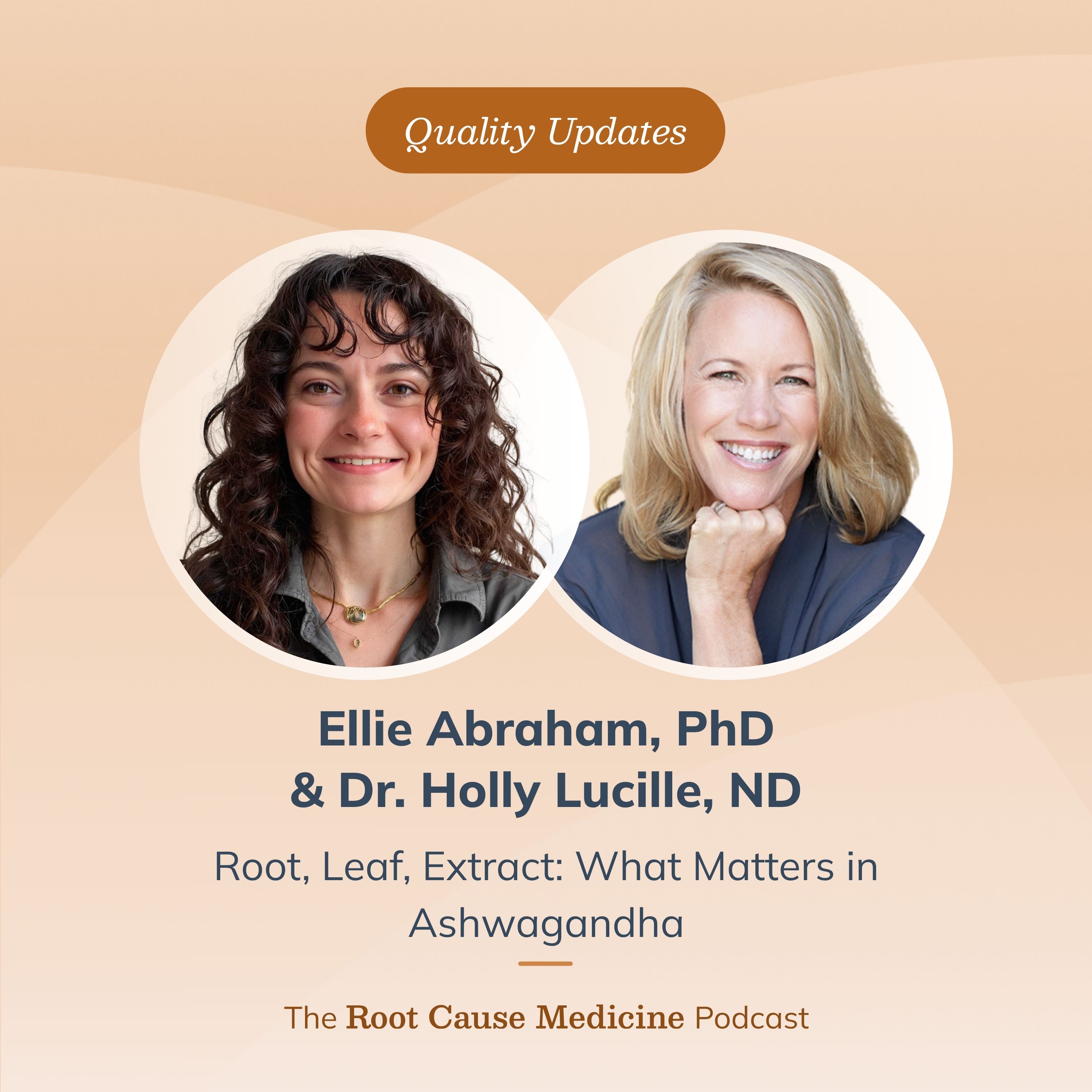
Root, Leaf, Extract: What Matters in Ashwagandha


Dr. Holly Lucille is joined by Ellie Abraham, PhD, to explain why two ashwagandha supplements may not be the same, even when they list the same ingredient. (Thalhamer 2024) This conversation covers differences between root and leaf extracts, withanolide standardization, botanical identity testing, certificates of analysis, and manufacturing quality. It also emphasizes that a well-made product may still not be appropriate for every patient. (NCCIH 2025)
Clinical Takeaways
- Plant part matters. Ashwagandha root, leaf, and combined extracts may have different chemical profiles and should not automatically be treated as interchangeable. (Chaurasiya 2008)
- Higher is not always better. The most concentrated product is not necessarily the safest or most effective. Clinical relevance depends on the extract, dose, intended use, and supporting research. (Thalhamer 2024) (NCCIH 2025)
- Quality testing matters. Botanical authentication, contaminant testing, certificates of analysis, and cGMP compliance can help confirm that a product meets its specifications. (ECFR 2026)
- Quality does not equal clinical fit. Patient history, medications, allergies, diagnoses, and potential interactions must still be considered. (NCCIH 2025)
Guest: Ellie Abraham has a PhD in plant biology and a background in analytical chemistry, ethnobotany, botanical testing, and dietary supplement quality control. She explains how manufacturers and laboratories verify botanical identity, plant part, standardization, contaminants, and product documentation.
Clinician FAQ
1. Are all ashwagandha supplements the same? No. Products may differ in plant part, extraction method, dose, standardization, chemical profile, and manufacturing quality. (Thalhamer 2024)
2. Why does ashwagandha root versus leaf matter? The root and leaf of ashwagandha contain different combinations of plant compounds. These differences may affect the product’s clinical properties, supporting research, and safety profile. (Chaurasiya 2008)
3. What does “standardized to 5% withanolides” mean? It means withanolides account for approximately 5% of the tested material. It does not identify each individual withanolide or describe the rest of the extract. (Thalhamer 2024)
4. Is a higher withanolide percentage better? Not necessarily. A higher percentage does not automatically mean that a product is safer or more effective. The appropriate concentration depends on the extract, dose, intended use, and supporting research. (Thalhamer 2024)
5. Can ashwagandha cause liver injury? Rare cases of liver injury associated with ashwagandha products have been reported. The exact cause and individual risk factors remain uncertain, but practitioners should consider supplement use when evaluating unexplained liver symptoms or abnormal liver tests. (NCBI 2012) (Philips 2023) (Björnsson 2020)
Timestamps / Key Moments
00:01:43 Ellie Abraham’s background in botanical testing
00:02:36 The ashwagandha leaf discussion in India
00:04:00 Differences between root and leaf
00:05:44 How botanical identity is verified
00:07:25 Why standardization matters
00:09:07 Why higher withanolides are not always better
00:10:56 Comparing two ashwagandha products
00:12:17 Red flags on supplement labels
00:14:42 When to request a certificate of analysis
00:16:27 Why cGMP compliance matters
Botanicals and Compounds Discussed
- Ashwagandha root and leaf
- Withanolides
- Glycosides
- Withanone
- Curcumin and curcuminoids
Quality Methods and Documents Discussed
- Botanical identity testing
- Plant-part verification
- HPTLC chemical fingerprinting
- Standardization testing
- Adulterant screening
- Microbial and heavy-metal testing
- Certificates of analysis
- Third-party testing
- cGMP compliance
- Batch-to-batch consistency
- Branded ingredient research
Want to elevate your practice? This episode is sponsored by Fullscript, a comprehensive care delivery platform designed to support whole-person, integrative healthcare. Fullscript allows clinicians to streamline supplement dispensing, lab ordering, and patient education in one free, centralized system—helping reduce administrative burden while supporting clinical decision-making. For practitioners, Fullscript offers access to professional-grade supplements, evidence-informed protocols, and lab integrations that can support more efficient planning and follow-up. For patients, it provides a clear, organized way to receive recommendations, manage refills, and stay engaged in their care. The goal is not to replace clinical judgment, but to make it easier for clinicians to focus on what matters most: thoughtful, individualized patient care.
Disclaimer
The views expressed on this podcast are those of the host and guest and do not necessarily reflect those of Fullscript or affiliated organizations. This episode is for educational purposes only and is not medical advice. Dietary supplements may cause side effects or interact with medications. Patients should consult a qualified healthcare professional before changing their healthcare routine.
References
- Björnsson, H. K., Björnsson, E. S., Avula, B., Khan, I. A., Jonasson, J. G., Ghabril, M., Hayashi, P. H., & Navarro, V. (2020). Liver injury due to ashwagandha: A case series from Iceland and the U.S. Drug-Induced Liver Injury Network. Liver International, 40(4), 825–829. https://pubmed.ncbi.nlm.nih.gov/31991029/
- Chaurasiya, N. D., Uniyal, G. C., Lal, P., Misra, L., Sangwan, N. S., Tuli, R., & Sangwan, R. S. (2008). Analysis of withanolides in root and leaf of Withania somnifera by HPLC with photodiode array and evaporative light scattering detection. Phytochemical Analysis, 19(2), 148–154. https://pubmed.ncbi.nlm.nih.gov/17879227/
- ECFR. (2026). Current good manufacturing practice in manufacturing, packaging, labeling, or holding operations for dietary supplements (21 C.F.R. Part 111). https://www.ecfr.gov/current/title-21/chapter-I/subchapter-B/part-111
- National Center for Complementary and Integrative Health (NCCIH). (2025). Ashwagandha. National Institutes of Health, U.S. Department of Health and Human Services. https://www.nccih.nih.gov/health/ashwagandha
- National Institute of Diabetes and Digestive and Kidney Diseases (NIDDK). (2024). Ashwagandha. In LiverTox: Clinical and research information on drug-induced liver injury. https://www.ncbi.nlm.nih.gov/books/NBK548536/
- NCBI. (2012). Ashwagandha [Review of Ashwagandha]. PubMed; National Institute of Diabetes and Digestive and Kidney Diseases. https://www.ncbi.nlm.nih.gov/books/NBK548536/
- Philips, C. A., Valsan, A., Theruvath, A. H., Ravindran, R., Oommen, T. T., Rajesh, S., Bishnu, S., & Augustine, P. (2023). Ashwagandha-induced liver injury: A case series from India and literature review. Hepatology Communications, 7(10), e0270. https://pubmed.ncbi.nlm.nih.gov/37756041/
- Thalhamer, B., Himmelsbach, M., Schatzmann, B., Klampfl, C., & Buchberger, W. (2024). A feasible procedure to detect widespread wrong labeling of ashwagandha root extracts in dietary supplements. Exploration of Foods and Foodomics, 2, 460–470. https://www.explorationpub.com/Journals/eff/Article/101046