
Dr. Kate Kresge
Dr. Holly Lucille
Dr. Lara Zakaria
Dr. Jessica Christie
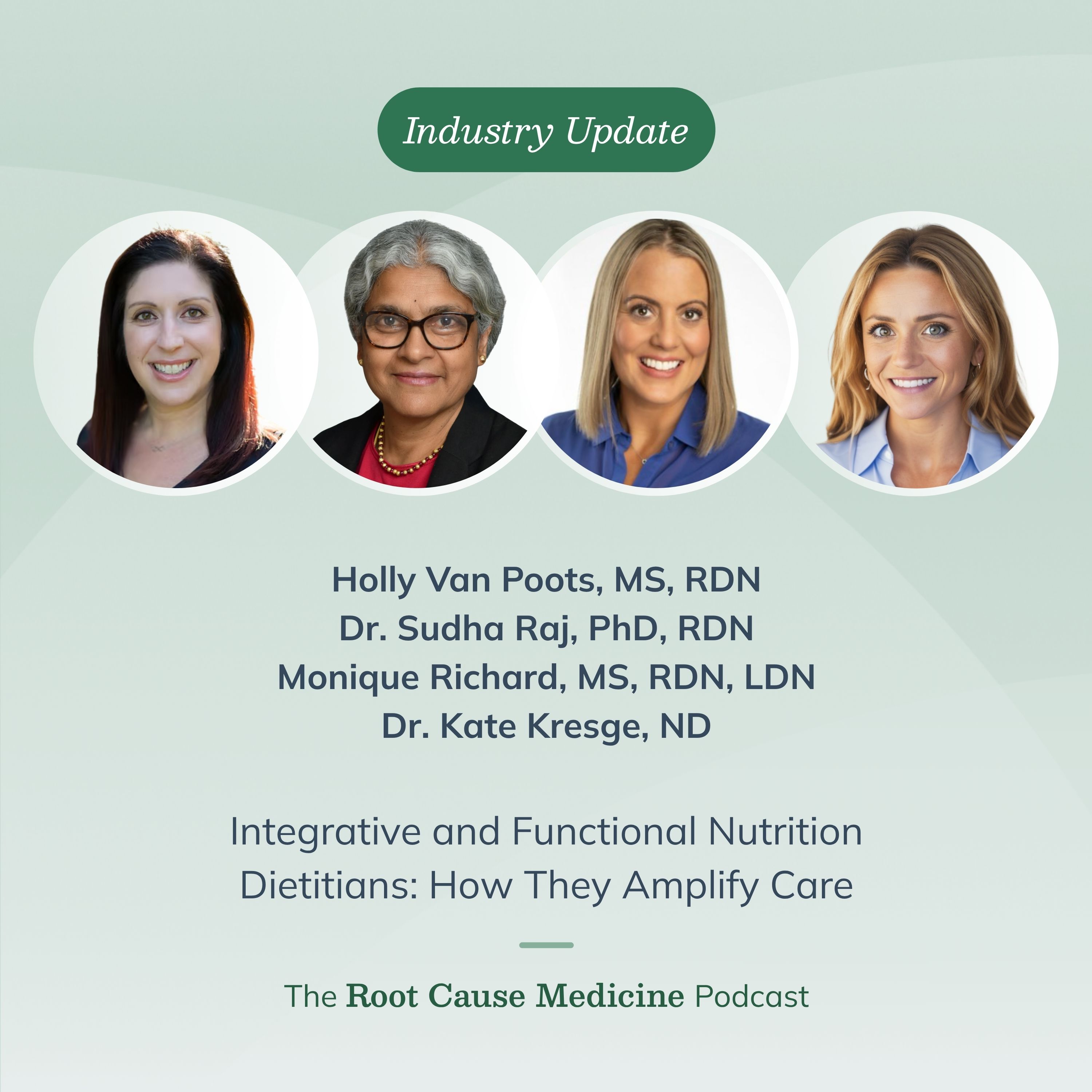
Integrative and Functional Nutrition Dietitians: How They Amplify Care


What happens when patients leave an integrative or functional medicine appointment with multiple recommendations but limited practical support for implementation?
In this episode, Kate Kresge sits down with Monique Richard, Holly Van Poots, and Sudha Raj to discuss the evolving role of Registered Dietitian Nutritionists (RDNs) trained in Integrative and Functional Nutrition (IFN). The conversation centers on the Revised 2025 Scope and Standards of Practice for RDNs in Nutrition in Integrative and Functional Medicine, which clarifies the scope, standards, and clinical contribution of IFN practitioners. (Crowe-White 2025)
Together they explore why nutrition may remain underused in some conventional care settings, including concerns that many medical providers receive limited formal nutrition training. (Adams 2010) They also discuss why sustained behavior change often requires more time, context, and follow-up than a brief visit can provide, and why food choices are shaped by more than nutrient content alone. The discussion highlights how IFN dietitians can help translate complex plans into sustainable daily habits while helping patients connect symptoms, lifestyle patterns, culture, stress, and nutrition.
The episode makes a practical case for team-based care and shows how integrative nutrition practitioners can help bridge the gap between clinical recommendations and meaningful long-term change.
Clinical Takeaways From This Episode
Behavior Change Is Often the Missing Piece
Many visits focus on diagnosis and treatment decisions, while meaningful behavior change takes time, relationship-building, and ongoing support. (Crowe-White 2025) (Körner 2016) IFN dietitians help patients put recommendations into practice in real-world settings.
Food Is More Than Nutrients
Food choices are shaped by culture, identity, family history, emotional experience, access, and lifestyle. Accounting for these factors may help make nutrition recommendations more realistic, acceptable, and sustainable; effects on clinical outcomes depend on the condition, intervention, and patient context. (Odoms-Young 2024) (Crowe-White 2025)
Nutrition Is Central to Complex Chronic Disease
Many patients present with concerns where nutrition may be one component of care, including issues related to digestive health, metabolic health, immune function, and quality of life. (Crowe-White 2025) (Moloney 2025)
Dietitians Serve as Translators of Functional Medicine Plans
Many patients leave appointments with extensive recommendations. IFN practitioners can help patients prioritize, personalize, and implement clinician recommendations within the patient’s preferences, resources, culture, and care plan. (Moloney 2025) (Senkus 2024)
Team-Based Care Improves Patient Support
Integrative care tends to work best when physicians, naturopathic doctors, nurse practitioners, health coaches, and nutrition professionals collaborate on whole-person care. (Körner 2016) (Crowe-White 2025)
Guest Introduction
Monique Richard, MS, RDN, LDN
Monique Richard is an experienced registered dietitian nutritionist specializing in integrative and functional nutrition. Known for her practical and patient-centered approach, she helps individuals explore lifestyle, nutrition, and environmental factors that may be relevant to their health goals and care plans. She often describes IFN practitioners as "nutrition detectives" who help connect the dots between symptoms, habits, and underlying patterns.
Holly Van Poots, MS, RDN
Holly Van Poots is a leader in integrative and functional nutrition education and one of the contributors to the newly published guidance paper on the role of IFN dietitians. Her work focuses on defining how nutrition professionals contribute to whole-person care beyond traditional dietary counseling.
Sudha Raj, PhD, RDN
Sudha Raj brings a deep understanding of nutrition behavior change, cultural competency, and patient-centered care. Her work emphasizes the importance of relationship-based nutrition counseling and understanding the lived experiences that shape food choices and health behaviors.
The statements, information and opinions shared by each individual are not in the capacity as official spokespeople, or, on behalf, of the Academy of Nutrition and Dietetics. They volunteered to be authors/contribute to the NIFM SOP and received no funding from the Academy.
FAQ
What is integrative and functional nutrition?
Integrative and functional nutrition combines evidence-informed nutrition science with a whole-person approach that considers lifestyle, environment, stress, sleep, culture, and other contributors to health.
How is an IFN dietitian different from traditional nutrition counseling?
While foundational nutrition principles remain the same, IFN practitioners often spend more time exploring nutrition- and lifestyle-related factors, patient context, and personalized behavior-change strategies.
Why are dietitians important in functional medicine practices?
Dietitians can help patients translate complex recommendations into practical daily actions, which may support adherence and follow-through. Evidence for clinical outcomes varies by condition and intervention. (Moloney 2025)
What are patients often missing after a functional medicine visit?
Patients frequently understand what they should do but struggle with how to implement recommendations. IFN practitioners help bridge that gap.
Why is food considered more than just nutrition?
Food carries cultural, emotional, social, and historical meaning. Accounting for these factors can help build realistic, sustainable nutrition strategies. (Odoms-Young 2024)
Timestamps
00:00:00 – Why nutrition changes are powerful but hard for patients to implement
00:02:17 – Why the new IFN dietitian scope paper matters now
00:03:51 – Integrative vs. functional nutrition and the “nutrition detective” role
00:05:00 – The biggest gaps IFN-trained RDNs can fill in patient care
00:08:22 – What a visit with an integrative and functional RDN actually looks like
00:12:16 – How labs and testing fit into nutrition care
00:15:11 – How dietitians train in integrative and functional nutrition
00:18:59 – Eating disorders, elimination diets, and the need for collaboration
00:25:55 – Where to find IFN-trained dietitians and build referral relationships
00:29:43 – The future of medical nutrition, value-based care, and whole person health
00:35:09 – Rapid-fire: misconceptions, sustainable habits, and underappreciated nutrition care
Future Discussion — The expanding role of RDNs in multidisciplinary healthcare teams
Want to elevate your practice? This episode is sponsored by Fullscript, a comprehensive care delivery platform designed to support whole-person, integrative healthcare. Fullscript allows clinicians to streamline supplement dispensing, lab ordering, and patient education in one free, centralized system—helping reduce administrative burden while supporting clinical decision-making. For practitioners, Fullscript offers access to professional-grade supplements, evidence-informed protocols, and lab integrations that can support more efficient planning and follow-up. For patients, it provides a clear, organized way to receive recommendations, manage refills, and stay engaged in their care. The goal is not to replace clinical judgment, but to make it easier for clinicians to focus on what matters most: thoughtful, individualized patient care.
Disclaimer: The views expressed on this podcast are those of the hosts and guests and don’t necessarily reflect those of Fullscript or any affiliated organizations. This podcast is for informational and educational purposes only and is not intended to be medical advice. For your safety, always check with your doctor or healthcare provider before making changes to your health routine.
References
- Adams, K. M., Kohlmeier, M., & Zeisel, S. H. (2010). Nutrition education in U.S. medical schools: Latest update of a national survey. Academic Medicine, 85(9), 1537–1542. https://doi.org/10.1097/ACM.0b013e3181eab71b
- Crowe-White, K. M., Richard, M., & Raj, S. (2025). Revised 2025 scope and standards of practice for registered dietitian nutritionists in nutrition in integrative and functional medicine. Commission on Dietetic Registration. https://www.cdrnet.org/vault/2459/web//20251215%20NIFM%20Article%20FINAL%20-%202.pdf
- Federal Trade Commission. (2022). Health products compliance guidance. https://www.ftc.gov/business-guidance/resources/health-products-compliance-guidance
- Körner, M., Bütof, S., Müller, C., Zimmermann, L., Becker, S., & Bengel, J. (2016). Interprofessional teamwork and team interventions in chronic care: A systematic review. Journal of Interprofessional Care, 30(1), 15–28. https://doi.org/10.3109/13561820.2015.1051616
- Moloney, L., Rozga, M., Steiber, A., & Handu, D. (2026). The effectiveness of medical nutrition therapy in prevention and treatment of chronic disease: A position paper of the Academy of Nutrition and Dietetics. Journal of the Academy of Nutrition and Dietetics, 126(2), Article 156219. https://doi.org/10.1016/j.jand.2025.10.010
- Odoms-Young, A., Stanford, F. C., Palacios, C., Anderson, C. A. M., Andres, A., Fisher, J. O., Gardner, C. D., Giovannucci, E., Hoelscher, D. M., Jernigan, V. B. B., Raynor, H. A., Webster, A., Fultz, A. K., Bahnfleth, C., English, L. K., Higgins, M., Lawless, M., Momin, S., Butera, G., … Obbagy, J. (2024). Culturally tailored dietary interventions and diet-related psychosocial factors, dietary intake, diet quality, and health outcomes: An evidence scan. U.S. Department of Agriculture, Nutrition Evidence Systematic Review. https://doi.org/10.52570/NESR.DGAC2025.ES01
- Senkus, K. E., Dudzik, J. M., Lennon, S. L., DellaValle, D. M., Moloney, L. M., Handu, D., & Rozga, M. (2024). Medical nutrition therapy provided by a dietitian improves outcomes in adults with prehypertension or hypertension: A systematic review and meta-analysis. The American Journal of Clinical Nutrition, 119(6), 1417–1442. https://doi.org/10.1016/j.ajcnut.2024.04.012