
Dr. Kate Kresge
Dr. Holly Lucille
Dr. Lara Zakaria
Dr. Jessica Christie
Adult Acne, Hormones, and Perimenopause: What Your Skin Is Trying to Tell You


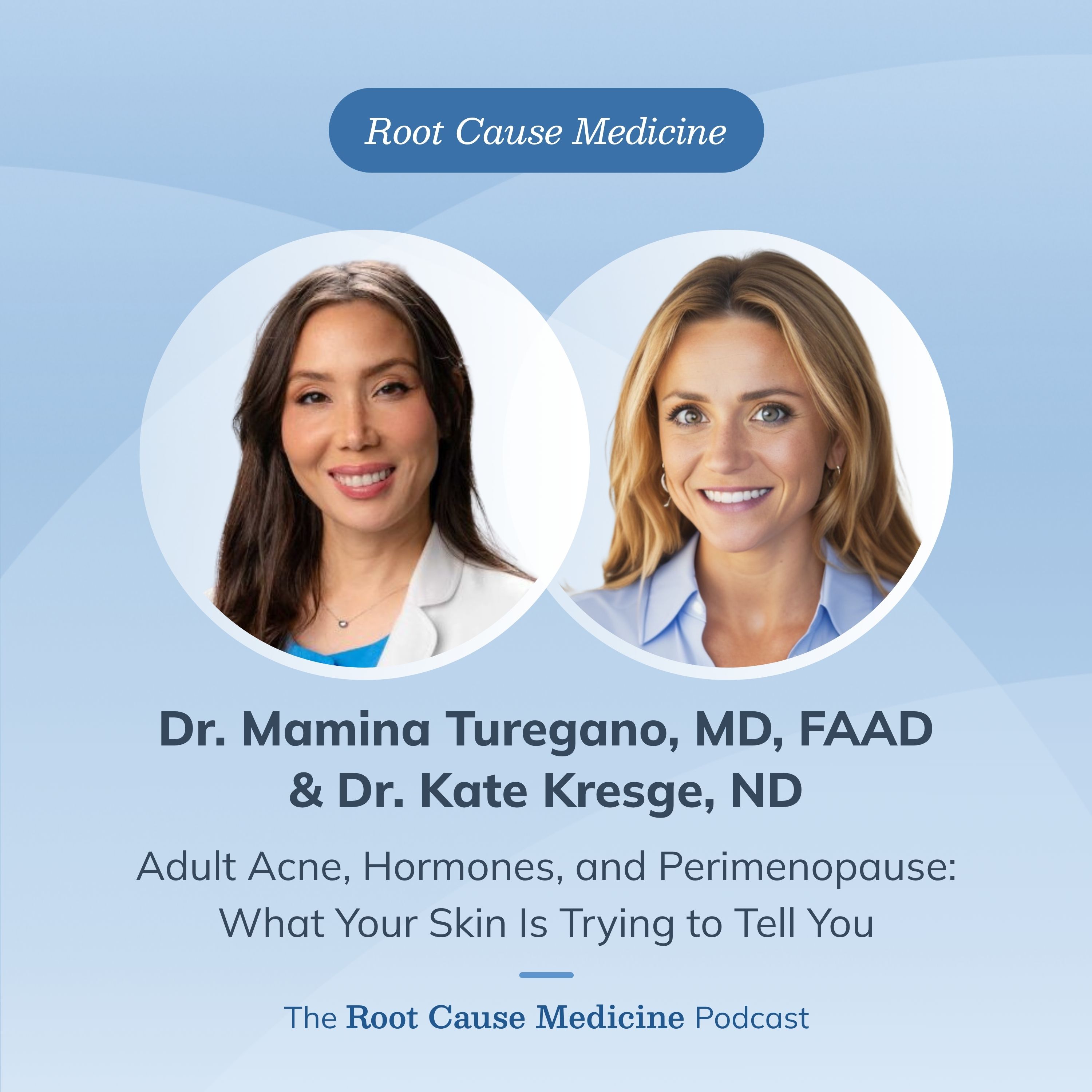
Adult Acne in Perimenopause: Hormones, Diet, Supplements, and Root Causes With Dr. Mamina Turegano
Adult acne can be especially frustrating when it appears after years—or even decades—of relatively clear skin. In this bonus episode, Dr. Kate Kresge sits down with dermatologist Dr. Mamina Turegano to explore why acne often emerges or worsens during perimenopause and what may be driving those changes beneath the surface.
Dr. Turegano explains how shifting hormone patterns, particularly changes in the balance between estrogen and androgens, may contribute to breakouts during midlife. She also discusses the potential roles of stress, diet, skincare habits, environmental exposures, and select supplements in acne management.
The conversation offers a practical, evidence-informed look at adult female acne, emphasizing individualized treatment approaches that support both skin health and overall wellbeing.
Why This Matters
Many women are surprised when acne appears in their 30s, 40s, or 50s. Adult female acne is increasingly common and often requires a different treatment approach than adolescent acne. Understanding the hormonal, metabolic, and lifestyle factors that may contribute to breakouts can help patients make more informed decisions about treatment and self-care.
Key Clinical Takeaways
Perimenopause may contribute to acne flares
Hormonal changes during the menopausal transition may alter the balance between estrogen and androgen activity, contributing to increased sebum production and acne in susceptible individuals. (Bagatin 2019) (Alexandre 2024)
Adult skin requires a different acne strategy
Compared to adolescent acne, adult female acne often occurs in skin that is more prone to dryness, irritation, and barrier dysfunction, making gentle treatment approaches especially important. (Dréno 2013)
Topical therapies remain foundational
Evidence-based acne management continues to rely heavily on topical retinoids, benzoyl peroxide, and other targeted therapies such as azelaic acid. (Reynolds 2024)
Diet may influence acne severity
Research suggests that higher-glycemic dietary patterns may contribute to acne severity, while evidence regarding dairy intake remains mixed and population dependent. (Meixiong 2022)
Supplements should be personalized
Some nutraceuticals—including zinc, probiotics, vitamin D, omega-3 fatty acids, and pantothenic acid—have been studied for acne support, but evidence varies considerably by ingredient and study quality. (Shields 2023)
Vitamin B12 may be a trigger in some individuals
Although uncommon, acneiform eruptions associated with vitamin B12 supplementation have been reported in the medical literature. (Bowden 2023)
Topics Covered
- Why adult acne is becoming more common
- Acne during perimenopause and menopause
- Hormonal changes and androgen activity
- Stress and skin health
- Environmental and lifestyle contributors
- Retinoids, azelaic acid, sulfur, and benzoyl peroxide
- When systemic therapies may be appropriate
- Diet, blood sugar regulation, and dairy
- Supplements commonly discussed for acne support
- Biotin, vitamin B12, and acne concerns
- Practical skincare strategies for adult women
Guest Bio
Dr. Mamina Turegano is a board-certified dermatologist with expertise in medical, surgical, and cosmetic dermatology. She is known for translating complex skin science into practical, patient-centered guidance and frequently speaks about acne, skin aging, hormone-related skin concerns, and integrative approaches to dermatologic care.
Timestamps
00:00 Introduction
02:04 Why adult acne develops during perimenopause
04:01 Adult acne versus teenage acne
05:00 Topical treatment approaches
07:22 Supplements and acne support
09:47 Biotin, vitamin B12, and breakouts
14:32 Acne in men versus women
15:35 Diet, dairy, fiber, and blood sugar
17:04 Final thoughts and resources
Sponsor Copy
Practitioners, what if your supplement dispensing, patient education, and treatment planning all lived in one powerful platform built for whole person care? Meet Fullscript—the comprehensive care delivery platform designed to reduce administrative burden and enhance clinical impact. From automated refills and lab ordering to evidence-based protocols and adherence support, Fullscript helps streamline care while keeping the focus where it belongs: on patients. In a recent survey, 74% of providers reported saving up to three hours per week using Fullscript to create treatment plans. Visit fullscript.com to learn more.
References
- Alexandre, M., Saint Aroman, M., Mengeaud, V., Carballido, F., Doat, G., Coutinho, A., & Bagatin, E. (2024). Unveiling the nuances of adult female acne: A comprehensive exploration of epidemiology, treatment modalities, dermocosmetics, and the menopausal influence. International Journal of Women’s Health, 16, 663–678. https://doi.org/10.2147/IJWH.S431523
- Bagatin, E., de Freitas, T. H. P., Rivitti-Machado, M. C., Ribeiro, B. M., Nunes, S., & da Rocha, M. A. D. (2019). Adult female acne: A guide to clinical practice. Anais Brasileiros de Dermatologia, 94(1), 62–75. https://doi.org/10.1590/abd1806-4841.20198203
- Bowden, A., Ekeh, O., Brownstone, N. D., & Hsu, S. (2023). Acneiform eruption secondary to over-the-counter vitamin B12. Cureus, 15(8), Article e43275. https://doi.org/10.7759/cureus.43275
- Dréno, B., Layton, A., Zouboulis, C. C., López-Estebaranz, J. L., Zalewska-Janowska, A., Bagatin, E., Zampeli, V. A., Yutskovskaya, Y., & Harper, J. C. (2013). Adult female acne: A new paradigm. Journal of the European Academy of Dermatology and Venereology, 27(9), 1063–1070. https://doi.org/10.1111/jdv.12061
- Meixiong, J., Ricco, C., Vasavda, C., & Ho, B. K. (2022). Diet and acne: A systematic review. JAAD International, 7, 95–112. https://doi.org/10.1016/j.jdin.2022.02.012
- Reynolds, R. V., Yeung, H., Cheng, C. E., Cook-Bolden, F., Desai, S. R., Druby, K., Freeman, E. E., Keri, J. E., Stein, L. F., Tan, J. K. L., Tollefson, M. M., Weiss, J. S., Wu, P. A., Zaenglein, A. L., Han, J. M., & Barbieri, J. S. (2024). Guidelines of care for the management of acne vulgaris. Journal of the American Academy of Dermatology, 90(5), 1006–1030.e30. https://doi.org/10.1016/j.jaad.2023.12.017
- Shields, A., Ly, S., Wafae, B., Chang, Y.-F., Manjaly, P., Archila, M., Heinrich, C., Drake, L., Mostaghimi, A., & Barbieri, J. S. (2023). Safety and effectiveness of oral nutraceuticals for treating acne: A systematic review. JAMA Dermatology, 159(12), 1373–1382. https://doi.org/10.1001/jamadermatol.2023.3949