
Dr. Kate Kresge
Dr. Holly Lucille
Dr. Lara Zakaria
Dr. Jessica Christie
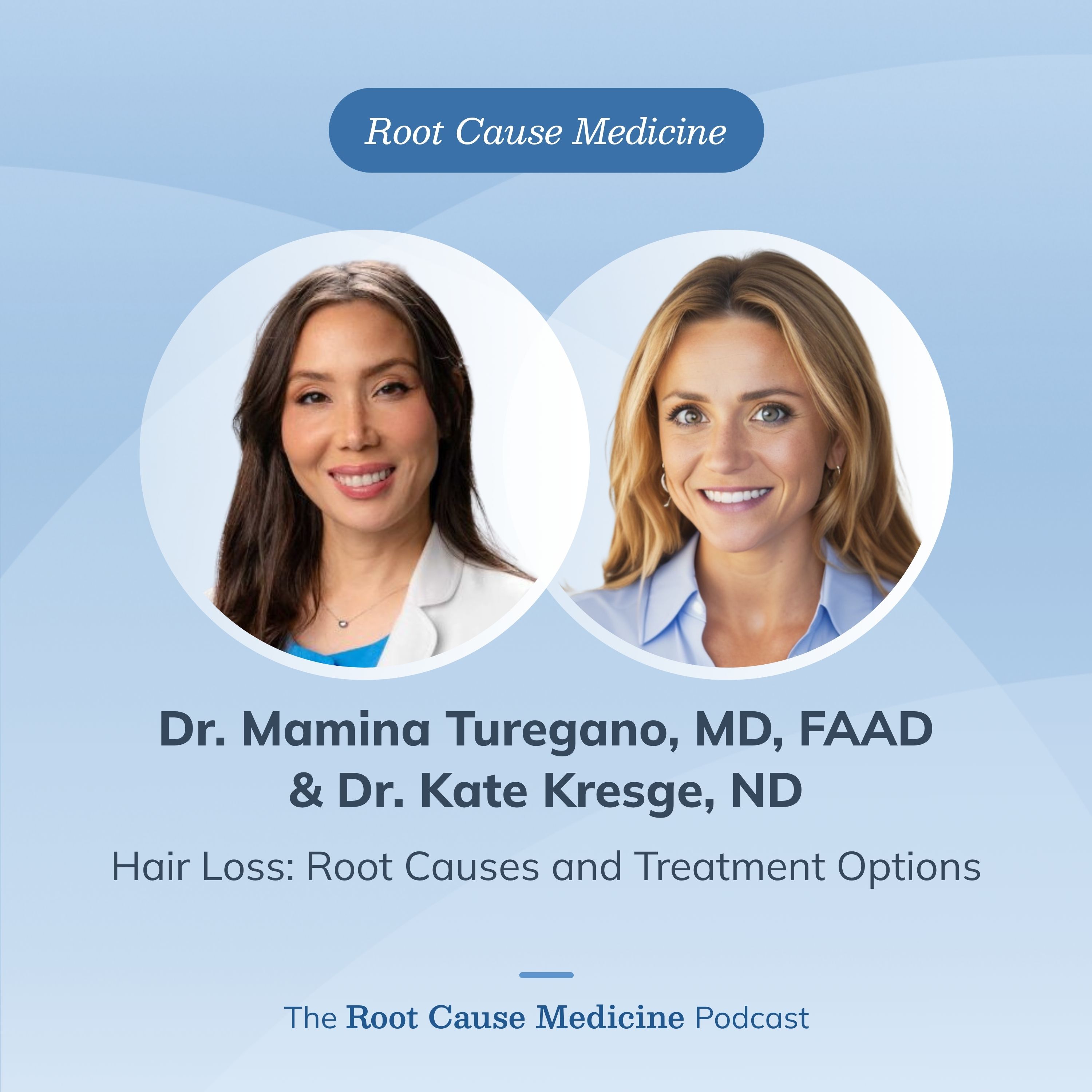
Hair Loss: Root Causes and Treatment Options


Hair loss can feel deeply personal, especially when it happens after illness, stress, rapid weight loss, postpartum changes, or a hormonal transition. In this episode, Dr. Mamina Turegano joins Dr. Kate Kresge to unpack the most common patterns of hair shedding and thinning, including telogen effluvium and androgenetic alopecia.
Dr. Turegano explains why hair loss is often multifactorial and why the timing matters: shedding may appear months after a physiologic or emotional stressor. She walks through the root-cause workup she considers in practice, including thyroid function, ferritin, vitamin D, B12, zinc, sex hormones, inflammation, scalp health, and medication history.
The conversation also covers postpartum hair loss, dandruff and scalp inflammation, protein intake, GLP-1-related weight loss, birth control changes, and evidence-informed options such as minoxidil, red light therapy, scalp massage, and PRP. Throughout the episode, Dr. Turegano brings a practical, compassionate approach to helping patients understand what may be driving hair loss and when a dermatology referral matters.
Clinical Takeaways from This Episode
- Telogen effluvium timing matters: Diffuse shedding often appears two to four months after a stressor such as illness, surgery, childbirth, hemorrhage, crash dieting, low protein intake, thyroid dysfunction, or medication changes. (Malkud 2015)(Hughes 2024)
- Pattern recognition guides the workup: Telogen effluvium, androgenetic alopecia, alopecia areata, traction alopecia, and scarring alopecias can look different clinically, which is why scalp exam and referral are important when diagnosis is uncertain. (Mubki 2014)
- Nutrient status can inform care: Ferritin, vitamin D, B12, zinc, and thyroid markers may help identify contributing factors in selected patients, though deficiencies are not the only explanation for shedding. (Ahmed 2026)(Durusu 2024)
- Postpartum shedding is common but still deserves context: Hormonal shifts, delivery-related stress, sleep disruption, breastfeeding, and blood loss may all contribute, and persistent or patterned loss should be evaluated. (Hirose 2023)
- Treatment should match the diagnosis: Topical minoxidil, low-level laser therapy, and PRP have evidence for androgenetic alopecia, but protocols, response, safety considerations, and patient context vary. (Adil 2017)(Perez 2024)(Yao 2024)
Guest Bio: Mamina Turegano, MD, is a triple board-certified dermatologist, internist, and dermatopathologist based in New Orleans. She specializes in medical, cosmetic, and integrative dermatology, blending conventional and holistic approaches to skin health. With over 2 million followers across social media, she shares dermatologist-backed skincare and wellness insights with a broad audience. She also co-hosts a podcast, called Skin Deep MDs, has been published in leading medical journals, and frequently contributes her expertise to major press outlets, TV, and beauty publications.
Frequently Asked Questions
What is telogen effluvium?
- Telogen effluvium is a form of diffuse, nonscarring hair shedding that often follows a physiologic or emotional stressor. The shedding commonly appears a few months after the trigger rather than immediately. (Malkud 2015)(Hughes 2024)
What labs may be useful for hair shedding?
- Depending on the patient’s history and exam, clinicians may consider CBC, ferritin, thyroid markers, vitamin D, B12, zinc, and selected hormone testing. Lab results should be interpreted in context rather than used as a stand-alone explanation. (Malkud 2015)(Durusu 2024)
Can postpartum hair loss be normal?
- Postpartum shedding is common and often related to hormonal shifts after delivery, but persistent, severe, patterned, or scarring hair loss should be evaluated. Blood loss, low iron stores, thyroid changes, and sleep disruption may also matter. (Hirose 2023)
Does washing hair make shedding worse?
- Not necessarily. Infrequent washing may make shedding look more dramatic because shed hairs accumulate between washes. Scalp inflammation or seborrheic dermatitis may also contribute to ongoing irritation and should be addressed when present.
When should a patient see a dermatologist for hair loss?
- Referral is especially important for patchy hair loss, scalp pain, itching, redness, scaling, shiny or scarred areas, rapid progression, frontal hairline recession, or hair loss that does not fit a clear trigger pattern. Scarring alopecias can cause permanent loss if not recognized early. (Mubki 2014)
Timestamps
00:00 — Why hair loss and shedding deserve a root-cause conversation
06:44 — Telogen effluvium vs androgenetic alopecia
10:31 — Ferritin, vitamin D, thyroid, B12, zinc, hormones, and ANA
15:09 — When to refer for scarring alopecia or autoimmune causes
17:54 — Hair washing, dandruff, scalp oil, and local inflammation
24:03 — GLP-1 medications, birth control, beta blockers, statins, and SSRIs
29:18 — Protein, calorie restriction, vegetarian diets, and nutrient status
35:42 — Postpartum shedding, hemorrhage, breastfeeding, and recovery
38:55 — Minoxidil, breastfeeding considerations, red light therapy, and PRP
44:15 — Scalp massage, circulation, and realistic supportive strategies
Want to elevate your practice? This episode is sponsored by Fullscript, a comprehensive care delivery platform designed to support whole-person, integrative healthcare. Fullscript allows clinicians to streamline supplement dispensing, lab ordering, and patient education in one free, centralized system—helping reduce administrative burden while supporting clinical decision-making. For practitioners, Fullscript offers access to professional-grade supplements, evidence-informed protocols, and lab integrations that can support more efficient planning and follow-up. For patients, it provides a clear, organized way to receive recommendations, manage refills, and stay engaged in their care. The goal is not to replace clinical judgment, but to make it easier for clinicians to focus on what matters most: thoughtful, individualized patient care.
Disclaimer: The views expressed on this podcast are those of the hosts and the guests, and they don't necessarily reflect the views of FullScript or any affiliated organizations. This podcast is for informational and educational purposes only, and it's not intended to be medical advice. For your safety, always check with your healthcare provider before making any changes to your healthcare routine.
Citations
- Adil A, Godwin M. The effectiveness of treatments for androgenetic alopecia: A systematic review and meta-analysis. J Am Acad Dermatol. 2017 Jul;77(1):136-141.e5. doi: 10.1016/j.jaad.2017.02.054. Epub 2017 Apr 7. PMID: 28396101.
- Ahmed A, Alali A, Alahmadi M, Alghamdi S, Khawaji Z, Humedi A, Alqurashi S. Association between Serum Trace Elements and Telogen Effluvium: A Systematic Review and Meta-Analysis. Skin Appendage Disord. 2026 Mar 18. doi: 10.1159/000550921. Epub ahead of print. PMID: 42077991; PMCID: PMC13134860.
- Durusu Turkoglu IN, Turkoglu AK, Soylu S, Gencer G, Duman R. A comprehensive investigation of biochemical status in patients with telogen effluvium: Analysis of Hb, ferritin, vitamin B12, vitamin D, thyroid function tests, zinc, copper, biotin, and selenium levels. J Cosmet Dermatol. 2024;23:4277-4284. doi:10.1111/jocd.16512
- Hirose A, Terauchi M, Odai T, Fudono A, Tsurane K, Sekiguchi M, Iwata M, Anzai T, Takahashi K, Miyasaka N. Investigation of exacerbating factors for postpartum hair loss: a questionnaire-based cross-sectional study. Int J Womens Dermatol. 2023 Jun 16;9(2):e084. doi: 10.1097/JW9.0000000000000084. PMID: 38323220; PMCID: PMC10846762.
- Hughes EC, Syed HA, Saleh D. Telogen Effluvium. 2024 May 1. In: StatPearls [Internet]. Treasure Island (FL): StatPearls Publishing; 2026 Jan–. PMID: 28613598.
- Malkud S. Telogen Effluvium: A Review. J Clin Diagn Res. 2015 Sep;9(9):WE01-3. doi: 10.7860/JCDR/2015/15219.6492. Epub 2015 Sep 1. PMID: 26500992; PMCID: PMC4606321.
- Mubki T, Rudnicka L, Olszewska M, Shapiro J. Evaluation and diagnosis of the hair loss patient: part I. History and clinical examination. J Am Acad Dermatol. 2014 Sep;71(3):415.e1-415.e15. doi: 10.1016/j.jaad.2014.04.070. PMID: 25128118.
- Perez SM, Vattigunta M, Kelly C, Eber A. Low-Level Laser and LED Therapy in Alopecia: A Systematic Review and Meta-Analysis. Dermatol Surg. 2025 Feb 1;51(2):179-183. doi: 10.1097/DSS.0000000000004442. Epub 2024 Oct 15. PMID: 39404126.
- Yao J, Zhu L, Pan M, Shen L, Tang Y, Fan L. The additive value of platelet-rich plasma to topical Minoxidil in the treatment of androgenetic alopecia: A systematic review and meta-analysis. PLoS One. 2024 Aug 28;19(8):e0308986. doi: 10.1371/journal.pone.0308986. PMID: 39197003; PMCID: PMC11356437.