
Dr. Kate Kresge
Dr. Holly Lucille
Dr. Lara Zakaria
Dr. Jessica Christie
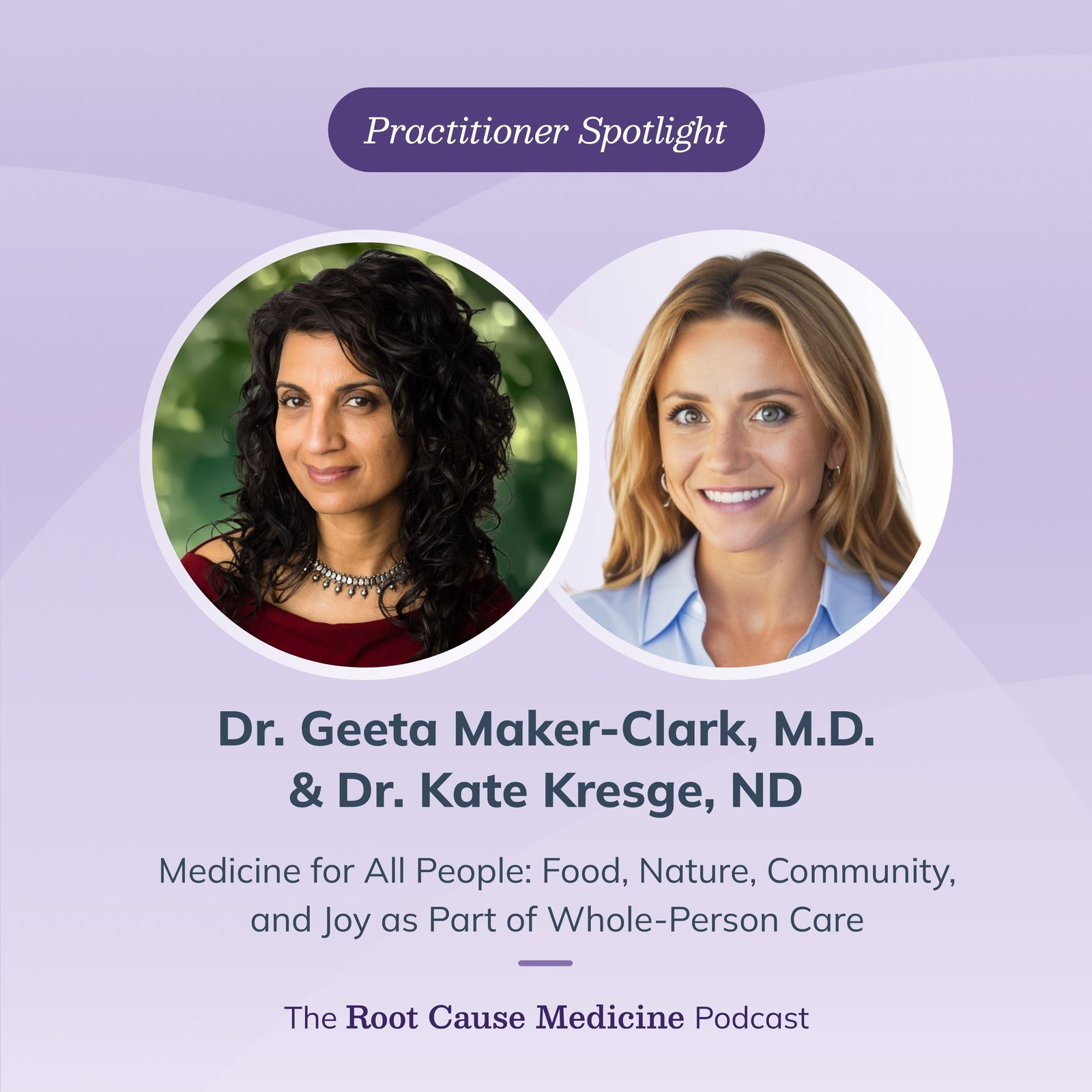
Medicine for All People: Food, Nature, Community, and Joy as Part of Whole-Person Care


Dr. Geeta Maker-Clark joins the Root Cause Medicine Podcast to discuss ideas from her book, Medicine for All People: Science and Ancient Wisdom for Revolutionary Healing. Drawing from family medicine, integrative medicine, culinary medicine, community health and her own upbringing, she explores a broader view of medicine that includes food, plants, nature, community, service, trust, dance, gratitude, and play.
The conversation centers on a simple idea: health is shaped not only by what happens in the clinic, but also by the environments, relationships, resources, cultural traditions, and daily practices that surround a person. Dr. Maker-Clark organizes these ideas into three areas—medicines of the earth, medicines of connection, and medicines of spirit—and discusses how practitioners can think about them alongside conventional medical care.
Clinical Takeaways
- Food and nutrition are part of whole-person care. Dr. Maker-Clark describes food as a central part of her clinical philosophy and discusses culinary medicine as a way to combine nutrition education with practical cooking skills. Her University of Chicago culinary medicine work includes medical students, community members, and middle school students, with an emphasis on nutrition literacy, accessibility, and culturally relevant food education. (Maker-Clark 2023)
- Nature exposure may support stress regulation and mental well-being. The episode frames time outdoors and connection with the natural environment as accessible ways to support well-being. Research has associated nature exposure with lower perceived and physiologic stress, although study designs, settings, and outcomes vary. (Shuda 2020)
- Social connection deserves attention in clinical assessment. Dr. Maker-Clark emphasizes community, belonging, and service as dimensions of health. Research supports associations between loneliness and social isolation and adverse cardiovascular, brain, mental health, and inflammatory outcomes, although mechanisms and the effectiveness of specific interventions continue to be studied. (Cené 2022) (Smith 2020)
- Trust includes both healthcare relationships and self-trust. The conversation explores how previous negative healthcare experiences, chronic illness, and unexplained symptoms can affect trust. Dr. Maker-Clark describes rebuilding trust through relationships and small, achievable commitments rather than treating trust as something patients should simply provide.
- Dance combines movement, cognition, emotion, and often social interaction. Dance is presented as an accessible form of joyful movement rather than a replacement for clinical care. Research suggests dance can influence cognitive and neuroplasticity-related outcomes, particularly in older adults, although effects vary by population and intervention. (Teixeira-Machado 2019) (Hewston 2021)
- Gratitude and play can be viewed as practices that support well-being. Gratitude interventions have shown generally modest benefits for well-being and some psychological outcomes. (Diniz 2023) (Kerry 2023) Adult play can take many forms, including creativity, competition, collecting, storytelling, exploration, and restorative activities. (Blanche 2024)
Guest: Geeta Maker-Clark, MD
Dr. Geeta Maker-Clark is a family and integrative medicine physician whose work spans patient care, nutrition education, culinary medicine, and community health. In the episode, she describes early clinical work in high-risk obstetrics and underserved communities as formative in expanding her understanding of health beyond the clinic.
She co-developed culinary medicine programming connected with the University of Chicago, including medical student education and community-based nutrition programs. Her book, Medicine for All People: Science and Ancient Wisdom for Revolutionary Healing, brings together themes of ancestral knowledge, scientific research, social justice, connection, and accessible approaches to well-being.
Clinician FAQ
1. What does Dr. Maker-Clark mean by “medicine for all people”?
She uses the phrase to describe a broader framework for health that includes conventional medicine alongside food, nature, relationships, community, cultural knowledge, and everyday practices. Accessibility and social justice are central themes in the framework.
2. What is culinary medicine?
Culinary medicine combines nutrition education with practical food preparation and cooking skills. In the program discussed in the episode, medical students learn nutrition counseling and cooking skills while community and middle school programs focus on nutrition literacy, food preparation, food justice, and culturally relevant education. (Maker-Clark 2023)
3. What does research say about nature exposure and stress?
Research generally supports an association between exposure to natural environments and improvements in some measures of perceived and physiological stress. Results vary across studies, and the effects depend on factors such as the population, type of nature exposure, comparison environment, and outcome measured. (Shuda 2020)
4. Why are loneliness and social connection clinically relevant?
Social isolation and loneliness have been associated with poorer cardiovascular and brain health and with some inflammatory markers. However, loneliness and objective social isolation are distinct concepts, and evidence does not establish that every health effect attributed to social disconnection operates through inflammation. (Cené 2022) (Smith 2020)
5. Can dance support brain health?
Dance combines physical movement with rhythm, learning, coordination, and sometimes social interaction. Systematic reviews have reported changes in cognitive and neuroplasticity-related outcomes, particularly among middle-aged and older adults. The magnitude of benefit and the cognitive domains affected vary across studies. (Teixeira-Machado 2019) (Hewston 2021) (Fong Yan 2024)
6. Does practicing gratitude improve mental health?
Gratitude interventions have been associated with small improvements in well-being and, in some studies, psychological symptoms. Results are heterogeneous, and gratitude should be viewed as a supportive practice rather than a substitute for appropriate mental healthcare. (Diniz 2023) (Kerry 2023)
Timestamps / Key Moments
00:01:41 Fullscript and whole-person care
00:02:39 Introducing Medicine for All People
00:03:09 How the book’s title and philosophy developed
00:06:07 Family medicine, obstetrics, and community health
00:07:18 How living conditions shaped Dr. Maker-Clark’s view of medicine
00:10:00 Food as a central part of whole-person care
00:11:02 Growing up with food and traditional practices
00:13:19 Bringing nutrition back into clinical practice
00:15:14 Culinary medicine and medical student education
00:16:03 Bringing food education into Chicago public schools
00:17:23 Plants, ancestral knowledge, and connection with the natural world
00:20:29 Developing relationships with plants in everyday environments
00:22:49 Plants and the history of medicines
00:24:52 Nature, stress regulation, and belonging
00:27:19 Access to nature as a health-equity issue
00:31:26 Community as a medicine of connection
00:35:16 Service, or seva, and connection with others
00:41:31 Trust in healthcare relationships
00:45:22 Rebuilding trust in the body during chronic illness
00:46:39 Small practices for rebuilding self-trust
00:49:21 Why dance, gratitude, and play are “medicines of spirit”
00:50:36 Dance, movement, and neuroplasticity
00:53:28 Dance as culture, ancestry, and expression
00:54:27 Gratitude without toxic positivity
00:58:22 Why adults still need play
01:00:44 Different adult play personalities
01:03:20 Play and social development
01:05:56 Where to find Dr. Maker-Clark and her book
Want to elevate your practice? This episode is sponsored by Fullscript, a comprehensive care delivery platform designed to support whole-person, integrative healthcare. Fullscript allows clinicians to streamline supplement dispensing, lab ordering, and patient education in one free, centralized system—helping reduce administrative burden while supporting clinical decision-making. For practitioners, Fullscript offers access to professional-grade supplements, evidence-informed protocols, and lab integrations that can support more efficient planning and follow-up. For patients, it provides a clear, organized way to receive recommendations, manage refills, and stay engaged in their care. The goal is not to replace clinical judgment, but to make it easier for clinicians to focus on what matters most: thoughtful, individualized patient care.
Disclaimer
The views expressed on this podcast are those of the host and guest and do not necessarily reflect those of Fullscript or affiliated organizations. This episode is for informational and educational purposes only and is not medical advice. Practices discussed in the episode should not replace individualized medical assessment or treatment. Patients should consult a qualified healthcare professional before making changes to their healthcare routine.
References
- Maker-Clark G, McHugh A, Shireman H, et al. Empowering Future Physicians and Communities on Chicago’s South Side through a 3-Arm Culinary Medicine Program. Nutrients. 2023;15(19):4212.
- Shuda Q, Bougoulias ME, Kass R. Effect of nature exposure on perceived and physiologic stress: A systematic review. Complement Ther Med. 2020;53:102514.
- Smith KJ, Gavey S, Riddell NE, Kontari P, Victor C. The association between loneliness, social isolation and inflammation: A systematic review and meta-analysis. Neurosci Biobehav Rev. 2020;112:519–541.
- Cené CW, Beckie TM, Sims M, et al. Effects of Objective and Perceived Social Isolation on Cardiovascular and Brain Health: A Scientific Statement From the American Heart Association. J Am Heart Assoc. 2022.
- Teixeira-Machado L, Arida RM, de Jesus Mari J. Dance for neuroplasticity: A descriptive systematic review. Neurosci Biobehav Rev. 2019;96:232–240.
- Hewston P, Kennedy CC, Borhan S, et al. Effects of dance on cognitive function in older adults: a systematic review and meta-analysis. Age Ageing. 2021;50(4):1084–1092.
- Fong Yan A, Nicholson LL, Ward RE, et al. The Effectiveness of Dance Interventions on Psychological and Cognitive Health Outcomes Compared with Other Forms of Physical Activity: A Systematic Review with Meta-analysis. Sports Med. 2024.
- Diniz G, Korkes L, Tristão LS, et al. The effects of gratitude interventions: a systematic review and meta-analysis. Einstein (São Paulo). 2023.
- Kerry N, Chhabra R, Clifton JDW. Being Thankful for What You Have: A Systematic Review of Evidence for the Effect of Gratitude on Life Satisfaction. Psychol Res Behav Manag. 2023;16:4799–4816.
- Blanche EI, Chang MC, Parham LD. Experiences of Adult Play. Am J Occup Ther. 2024;78(4).