
Dr. Kate Kresge
Dr. Holly Lucille
Dr. Lara Zakaria
Dr. Jessica Christie
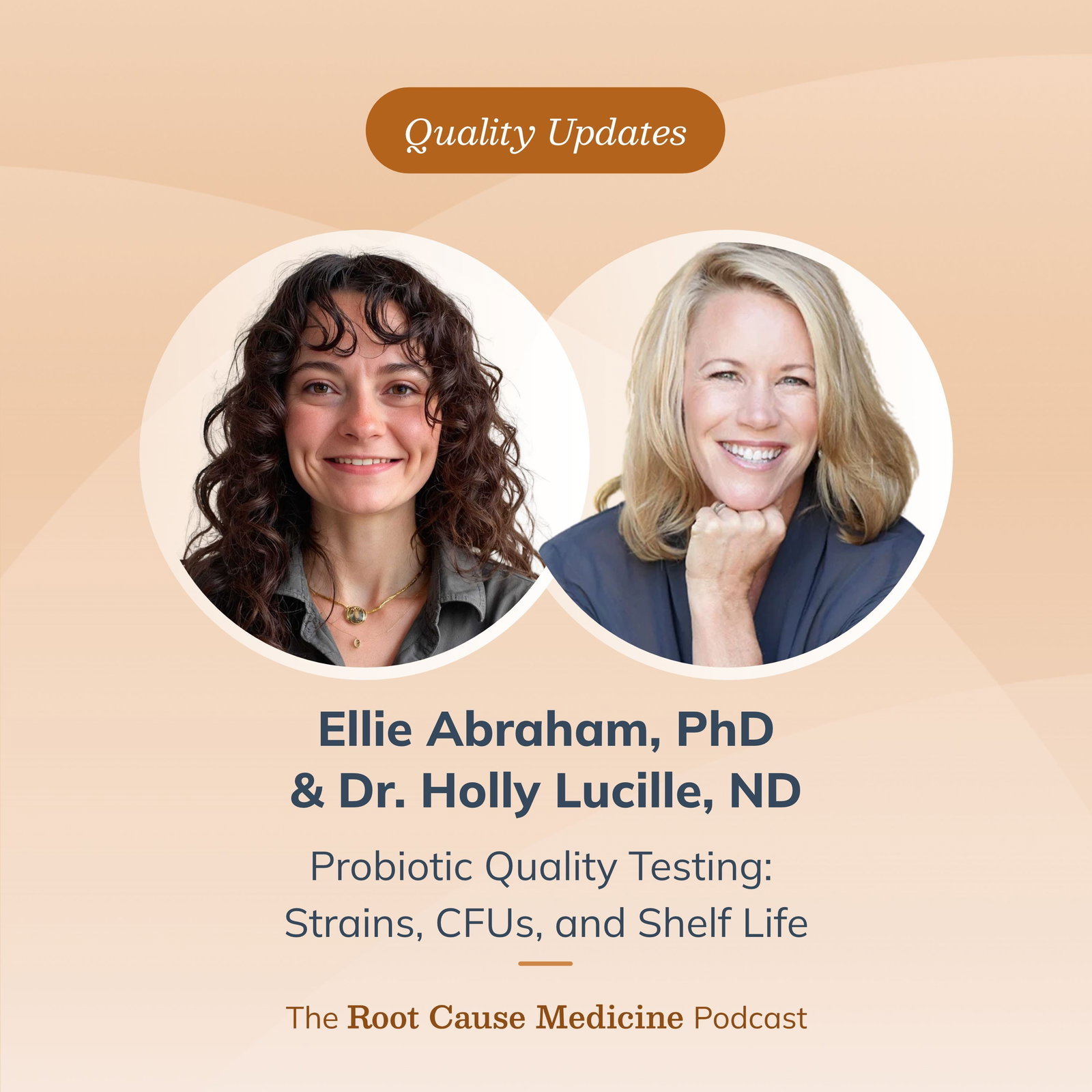
Probiotic Quality Testing: Strains, CFUs, and Shelf Life


Dr. Holly Lucille welcomes Ellie Abrams, PhD, from Fullscript’s Quality team to the Root Cause Medicine Podcast. They explore identity, potency, storage, and label claims.
Clinical Takeaways
- Start with strain-specific evidence. Abrams emphasizes matching the strain and studied amount to the intended outcome. A higher colony-forming unit (CFU) count alone does not establish a better product. (ODS 2025)
- Separate identity from potency. The episode distinguishes organism identification from enumeration, which measures quantity. (Jackson 2019) Neither test alone establishes clinical benefit.
- Ask about viability through expiration. Abrams highlights finished-product testing and stability data. Raw-material results alone do not demonstrate that the labeled amount remains viable throughout shelf life. (Fenster 2019)
Guest
Ellie Abrams, PhD, works on Fullscript’s Quality team. Her Penn State doctorate is in plant biology, with expertise in analytical chemistry, supplement authentication, and quality testing.
Clinician FAQ
1. What should clinicians look for on a probiotic label?
Look for strain identification, CFUs per serving, expiration date, and storage instructions, plus research relevant to the intended use. (ODS 2025)
2. Does a higher CFU count mean a better probiotic?
Abrams emphasizes the studied strain, amount, and intended outcome rather than comparing products by total CFUs alone. (ODS 2025)
3. How are probiotic identity and potency tested?
Abrams describes genetic identification and plate counts for CFUs. Flow cytometry measures cells differently and does not directly report CFUs. (Jackson 2019)
4. What is probiotic overage?
Overage is surplus material added during manufacturing to account for losses in viable organisms. Stability data should support shelf-life claims. (Fenster 2019)
5. Are probiotic gummies and beverages equivalent to capsules?
Format alone does not establish equivalence. Abrams discusses heat and moisture challenges and scrutiny of strain stability, protective technology, and testing. (Fenster 2019)
Key Moments
03:56 Identity testing and strain specificity
07:36 Reading labels and interpreting CFUs
12:12 Storage conditions and expiration dates
14:04 Survival testing and probiotic overage
15:59 Gummies, beverages, and formulation challenges
21:55 Questions to ask manufacturers
23:45 Fullscript’s product review and testing
Disclaimer
The views expressed on this podcast are those of the hosts and the guests, and they don't necessarily reflect the views of FullScript or any affiliated organizations. This podcast is for informational and educational purposes only, and it's not intended to be medical advice. For your safety, always check with your healthcare provider before making any changes to your healthcare routine.
References
- Fenster, K., Freeburg, B., Hollard, C., Wong, C., Rønhave Laursen, R., & Ouwehand, A. C. (2019). The production and delivery of probiotics: A review of a practical approach. Microorganisms, 7(3), 83. https://doi.org/10.3390/microorganisms7030083
- Jackson, S. A., Schoeni, J. L., Vegge, C., Pane, M., Stahl, B., Bradley, M., Goldman, V. S., Burguière, P., Atwater, J. B., & Sanders, M. E. (2019). Improving end-user trust in the quality of commercial probiotic products. Frontiers in Microbiology, 10, 739. https://doi.org/10.3389/fmicb.2019.00739
- Office of Dietary Supplements. (2025). Probiotics: Fact sheet for health professionals. National Institutes of Health. https://ods.od.nih.gov/factsheets/Probiotics-HealthProfessional/