
Dr. Kate Kresge
Dr. Holly Lucille
Dr. Lara Zakaria
Dr. Jessica Christie
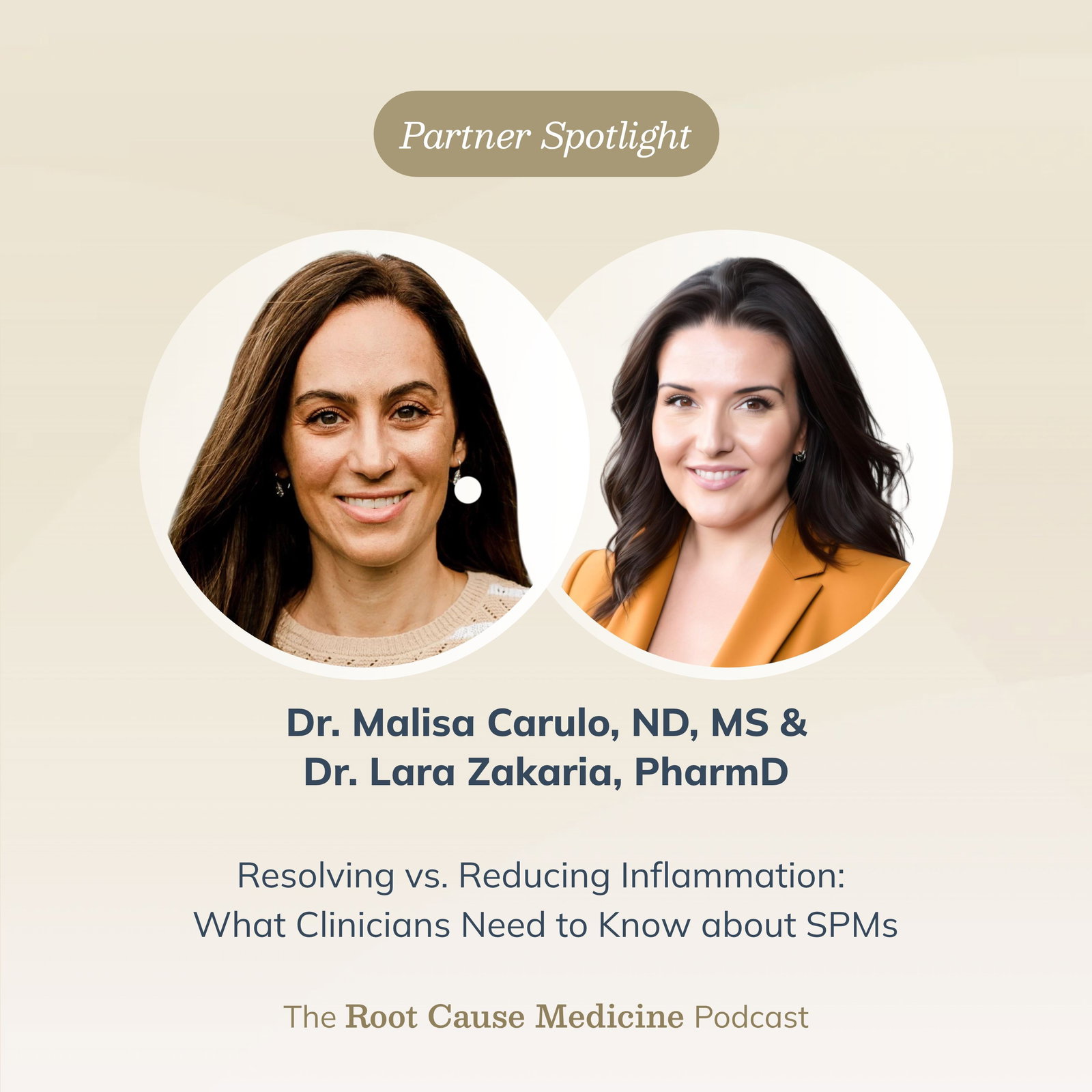
Resolving vs. Reducing Inflammation: What Clinicians Need to Know about SPMs


On the Root Cause Medicine Podcast, Dr. Lara Zakaria joins Dr. Malisa Carulo to explore specialized pro-resolving mediators (SPMs), omega-3-derived precursors, and emerging pain research, with a focus on evidence limits and clinical decision-making.
Clinical Takeaways
- Distinguish SPMs from their precursors. TSPMs are lipid signals that help steer inflammation toward resolution. (Serhan 2018) SPM-focused marine-oil supplements contain upstream intermediates, a few enzymatic steps closer to finished SPMs than EPA and DHA, but these are not equivalent to finished SPMs. (Souza 2020)
- Separate mechanisms from clinical outcomes. condition.Mechanistic research outpaces human trials, which so far center on pain and musculoskeletal conditions such as osteoarthritis. (Callan 2020) (Möller 2023) Evidence does not yet support broad benefits for autoimmune disease, gut health, or every inflammatory condition.
- Keep clinical response central. The conversation emphasizes pain, stiffness, and mobility alongside foundational care. Acute high-dose strategies and bedtime use are discussed as anecdotes, not validated protocols.
Guest
Dr. Malisa Carulo holds a doctorate in naturopathic medicine and an MS in biology. Introduced as Senior Manager of Medical Information and Safety at Metagenics, her interests include chronic disease, healthy aging, and sports medicine.
Clinician FAQ
1. What are specialized pro-resolving mediators?
SPMs, including resolvins, protectins, and maresins, as lipid signals involved in the active resolution of inflammation. (Serhan 2018)
2. How do SPM-focused supplements differ from fish oil?
The guest distinguishes EPA and DHA from downstream intermediates such as 18-HEPE, 17-HDHA, and 14-HDHA. This distinction alone does not establish superior clinical outcomes. (Möller 2023)
3. What evidence for SPMs and joint pain does the episode discuss?
The guest highlights early human research in musculoskeletal pain, including osteoarthritis, while acknowledging that clinical evidence remains limited relative to mechanistic research. (Callan 2020) (Möller 2023)
4. Are SPM supplements established therapies for autoimmune or gut conditions?
The discussion does not establish that use. The guest describes clinical experiences and biological hypotheses rather than condition-specific evidence sufficient to support broad treatment claims.
5. Does the episode establish an SPM dosing protocol?
No. Studies have used doses ranging from about 250 mg per day in early research to 500 mg and 1 g in human trials, but the guest cautions that evidence-guided dosing recommendations remain limited. (Callan 2020) (Möller 2023)
Key Moments
03:56 SPM biology and marine-oil intermediates
07:42 Conversion pathways and inflammation resolution
11:15 Mechanistic research versus human evidence
13:21 Evaluating formulations and clinical outcomes
18:44 Measurement limitations and pain research
24:38 Dosing discussion and anecdotal strategies
30:25 Tracking pain, stiffness, and mobility
Disclaimer
The views expressed on this podcast are those of the hosts and the guests, and they don't necessarily reflect the views of FullScript or any affiliated organizations. This podcast is for informational and educational purposes only, and it's not intended to be medical advice. For your safety, always check with your healthcare provider before making any changes to your healthcare routine.
References
- Callan, N., Hanes, D., & Bradley, R. (2020). Early evidence of efficacy for orally administered SPM-enriched marine lipid fraction on quality of life and pain in a sample of adults with chronic pain. Journal of Translational Medicine, 18(1), Article 401. https://doi.org/10.1186/s12967-020-02569-5
- Möller, I., Rodas, G., Villalón, J. M., Rodas, J. A., Angulo, F., Martínez, N., & Vergés, J. (2023). Randomized, double-blind, placebo-controlled study to evaluate the effect of treatment with an SPMs-enriched oil on chronic pain and inflammation, functionality, and quality of life in patients with symptomatic knee osteoarthritis: GAUDI study. Journal of Translational Medicine, 21(1), Article 423. https://doi.org/10.1186/s12967-023-04283-4
- Serhan, C. N., & Levy, B. D. (2018). Resolvins in inflammation: Emergence of the pro-resolving superfamily of mediators. Journal of Clinical Investigation, 128(7), 2657–2669. https://doi.org/10.1172/JCI97943
- Souza, P. R., Marques, R. M., Gomez, E. A., Colas, R. A., De Matteis, R., Zak, A., Patel, M., Collier, D. J., & Dalli, J. (2020). Enriched marine oil supplements increase peripheral blood specialized pro-resolving mediators concentrations and reprogram host immune responses: A randomized double-blind placebo-controlled study. Circulation Research, 126(1), 75–90. https://doi.org/10.1161/CIRCRESAHA.119.315506