
Hosted by
Dr. Carrie Jones
Dr. Kate Kresge
Dr. Holly Lucille
Dr. Lara Zakaria
Dr. Jessica Christie
Dr. Kate Kresge
Dr. Holly Lucille
Dr. Lara Zakaria
Dr. Jessica Christie
February 5, 2026
・
12
mins
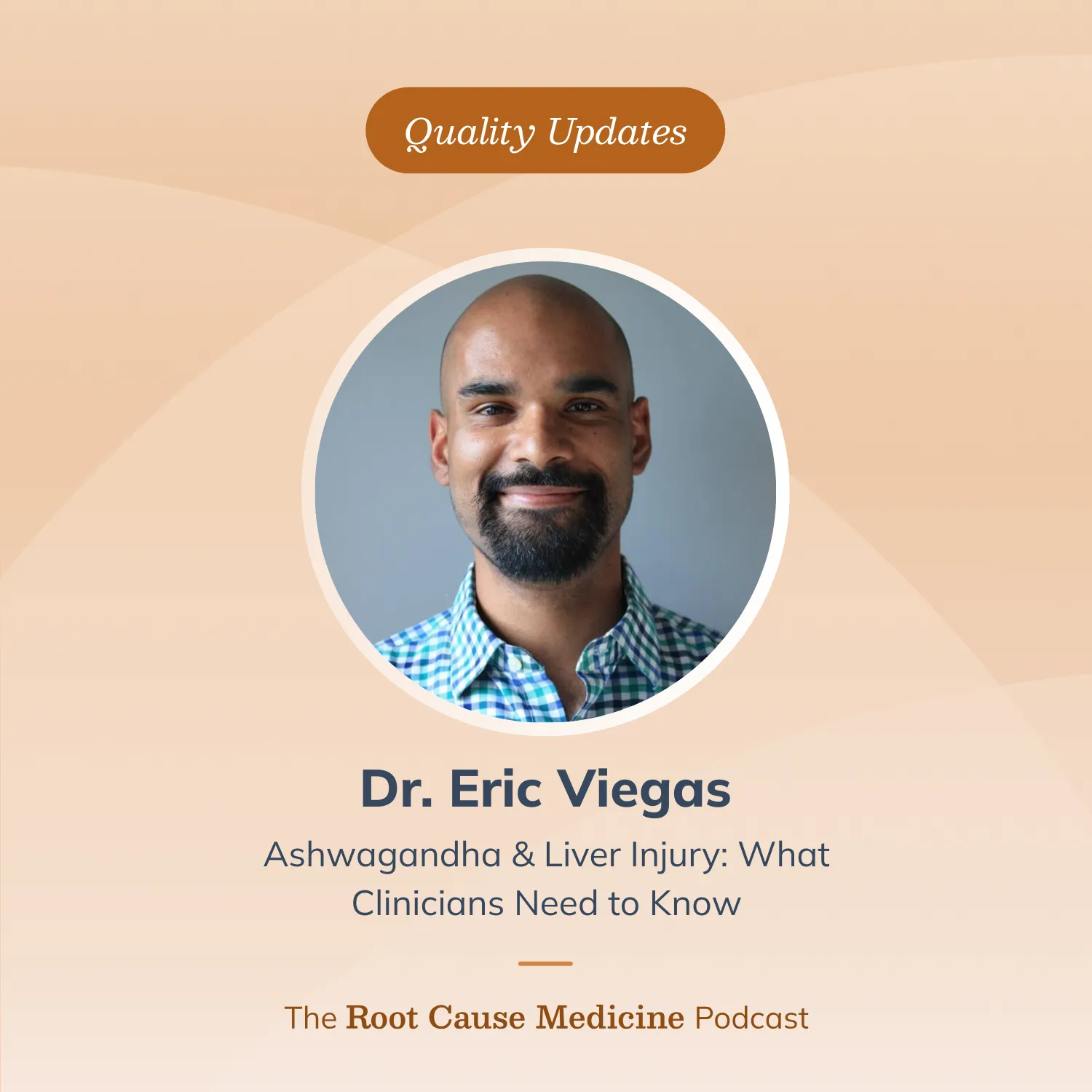
Ashwagandha & Liver Injury: What Clinicians Need to Know with Dr Eric Viegas


Transcription
See more

Summary
In this Root Cause Medicine podcast episode, Dr. Kate Kresge is joined by Dr. Eric Viegas, quality and safety lead at Fullscript, to explore emerging concerns around ashwagandha-associated drug-induced liver injury (DILI). While ashwagandha remains one of the most widely used adaptogens in integrative medicine, recent international case reports have highlighted rare but clinically meaningful hepatic adverse events. This episode equips clinicians with a mechanistic understanding of potential risk factors, withanolide content that may increase vulnerability, and practical strategies for patient screening, education, and monitoring—without dismissing the therapeutic value of this foundational herb.
Clinical Takeaways from This Episode
- Ashwagandha-Associated Drug-Induced Liver Injury (DILI) Is Rare but Documented
Case reports from Japan, Iceland, and the U.S. describe hepatocellular injury typically occurring within 2–12 weeks of initiation, often resolving after discontinuation (Björnsson, 2020). - Withanone and Oxidative Stress as a Proposed Mechanism
The withanolide withanone may contribute to genotoxic and oxidative stress, particularly in states of depleted glutathione, potentially impairing hepatic detoxification capacity (Siddiqui, 2021). - Withanolide Concentration Matters
Products standardized to high withanolide content may pose greater theoretical risk compared to traditional whole-root or aqueous preparations (Björnsson, 2020). - Patient Vulnerability Influences Risk Profile
Individuals with pre-existing liver concerns, polypharmacy, high oxidative stress burden, or impaired phase II detoxification may warrant closer consideration and monitoring (Siddiqui, 2021). - Clinical-Grade Supply Chains Support Risk Mitigation
Practitioner-dispensed platforms with transparent sourcing, certificates of analysis, and clear extract documentation may help reduce exposure to adulterated or mischaracterized products. - Patient Education and Monitoring Remain Frontline Tools
Counseling on symptom awareness and considering baseline and follow-up liver enzymes may support safer use when ashwagandha is clinically appropriate.
Guest Introduction
Dr. Eric Viegas is a quality expert at Fullscript, where he oversees supplement quality programs, supply chain integrity, and clinical-grade standards. With expertise in pharmacology, toxicology, and nutraceutical regulation, Dr. Viegas supports practitioners in making evidence-informed decisions around supplement sourcing, formulation, and patient safety. Learn more: https://fullscript.com
Labs, Nutrition, and Lifestyle Support
Liver Function and Safety Monitoring Labs
- Comprehensive Metabolic Panel (CMP)
- ALT
- AST
- Total and direct bilirubin
- Alkaline phosphatase, as clinically indicated (Björnsson, 2020)
Nutritional Considerations for Hepatic Resilience
- Adequate dietary protein to support glutathione synthesis (Siddiqui, 2021)
Lifestyle and Integrative Support Strategies
- Review of total supplement and medication load with attention to polypharmacy
- Patient education on early symptoms of liver stress such as fatigue, pruritus, dark urine, and jaundice (Björnsson, 2020)
All strategies are intended for educational support and clinical consideration and should be applied within the context of individualized care.
Sponsor
This episode is sponsored by Fullscript, a comprehensive care delivery platform designed to support whole-person, integrative healthcare. Fullscript allows clinicians to streamline supplement dispensing, lab ordering, and patient education in one free, centralized system—helping reduce administrative burden while supporting clinical decision-making. For practitioners, Fullscript offers access to professional-grade supplements, evidence-informed protocols, and lab integrations that can support more efficient treatment planning and follow-up. For patients, it provides a clear, organized way to receive recommendations, manage refills, and stay engaged in their care. The goal is not to replace clinical judgment, but to make it easier for clinicians to focus on what matters most: thoughtful, individualized patient care.
FAQs
1) Can ashwagandha cause liver injury?
Yes, but it appears to be rare. Published case series and reports describe ashwagandha-associated drug-induced liver injury (DILI) with symptom onset most often within weeks (commonly ~2–12 weeks) after starting, and improvement typically occurring after stopping the product. Clinicians should treat this as an uncommon, but plausible, idiosyncratic adverse event rather than a predictable toxicity for all users (Björnsson et al., 2020).
2) What are the typical symptoms of ashwagandha-related liver injury?
Reported presentations resemble other forms of DILI and may include fatigue, pruritus, dark urine, and jaundice; some patients may have nonspecific malaise before overt cholestatic or hepatocellular patterns are recognized on labs. Educate patients to discontinue the product and seek evaluation promptly if these symptoms occur (Björnsson et al., 2020).
3) How long after starting ashwagandha might liver injury show up?
In published cases, liver injury has typically appeared within 2 to 12 weeks after initiation (though individual variability exists, as with other DILI phenotypes). This timing supports a practical monitoring window for higher-risk patients, especially early in therapy (Björnsson et al., 2020).
4) Who is at higher risk for ashwagandha-associated DILI?
Risk appears to be influenced by host vulnerability and context, including pre-existing liver disease or prior liver injury, significant polypharmacy, and higher oxidative stress burden. Because DILI is often idiosyncratic, risk stratification is imperfect; however, these factors justify a more conservative approach and closer follow-up (Siddiqui et al., 2021; Björnsson et al., 2020).
5) What is the safest way to use ashwagandha clinically?
A clinically cautious approach is to:
- Prefer transparent, clinically vetted supply chains with clear extract specifications and quality documentation.
- Screen for liver history and medication/supplement load.
- Educate patients on early warning symptoms.
- Consider baseline and follow-up liver enzymes (e.g., ALT, AST, bilirubin) in higher-risk individuals or if symptoms develop.
- This framing supports safer use without implying the product is universally unsafe or “detoxifying,” and keeps claims within educational and clinical-monitoring boundaries (Björnsson et al., 2020; Siddiqui et al., 2021).
Citations
- Björnsson HK, Björnsson ES, Avula B, Khan IA, Jonasson JG, Ghabril M, Hayashi PH, Navarro V. Ashwagandha-induced liver injury: A case series from Iceland and the US Drug-Induced Liver Injury Network. Liver Int. 2020 Apr;40(4):825-829. doi: 10.1111/liv.14393. Epub 2020 Feb 11. PMID: 31991029; PMCID: PMC8041491.
- Siddiqui S, Ahmed N, Goswami M, Chakrabarty A, Chowdhury G. DNA damage by Withanone as a potential cause of liver toxicity observed for herbal products of Withania somnifera (Ashwagandha). Curr Res Toxicol. 2021;2:72-81. Published 2021 Feb 16. doi:10.1016/j.crtox.2021.02.002
Related Lab Tests
No items found.
Episode Highlights
No items found.
Recent Episodes