
Hosted by
Dr. Carrie Jones
Dr. Kate Kresge
Dr. Holly Lucille
Dr. Lara Zakaria
Dr. Jessica Christie
Dr. Kate Kresge
Dr. Holly Lucille
Dr. Lara Zakaria
Dr. Jessica Christie
March 26, 2026
・
25
mins
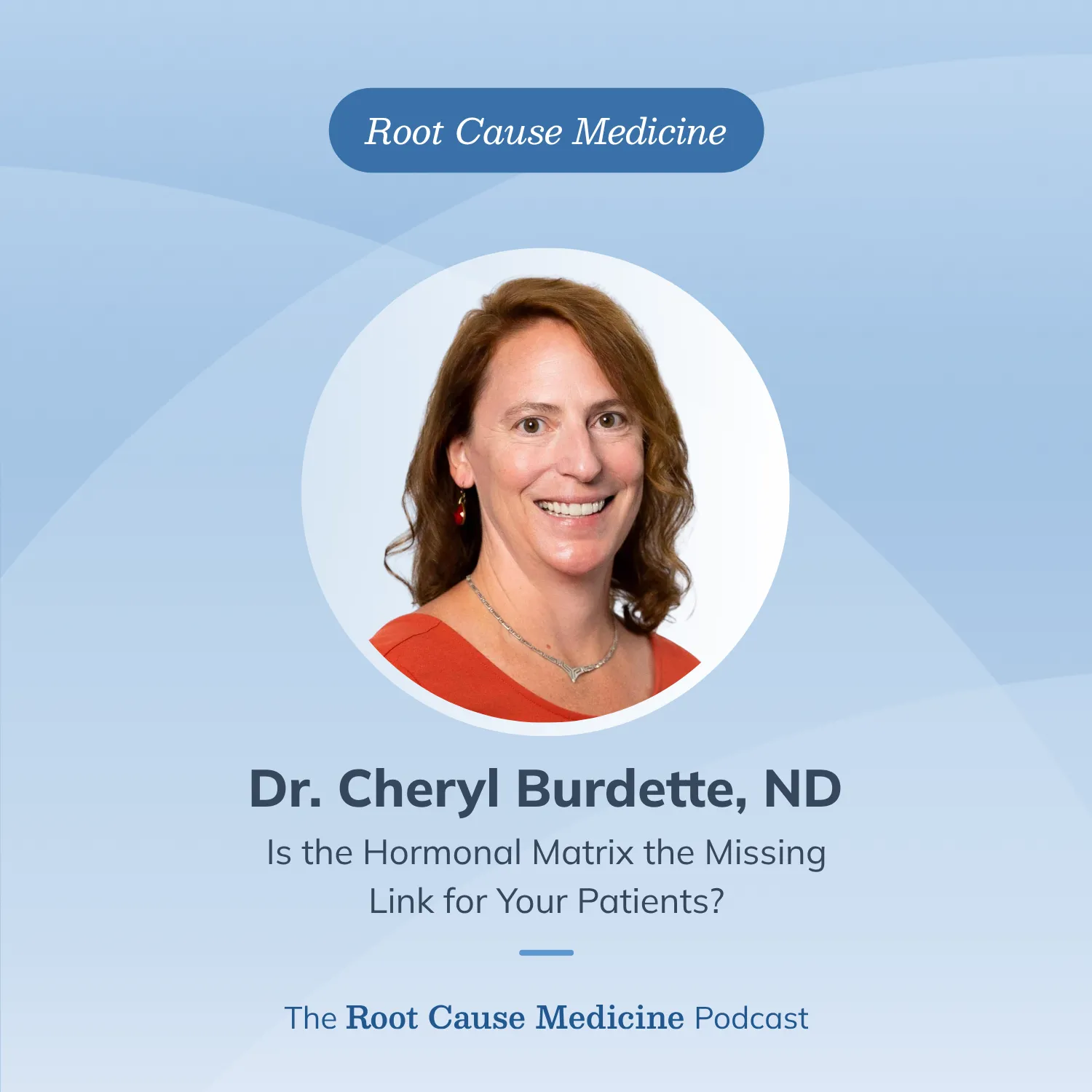
Is the Hormonal Matrix the Missing Link for Your Patients?


Transcription
See more

What if the real problem with hormones isn’t what’s broken… but what’s being missed?
In this conversation, Dr. Cheryl Burdette invites us to rethink everything we’ve been taught about hormonal health. Instead of chasing isolated lab values or treating systems in silos, she introduces a more useful question: what if hormones only make sense when you look at how they talk to each other?
We explore the concept of the hormonal matrix—a lens that connects thyroid, adrenal, and reproductive hormones into one dynamic, interdependent network. Because in the body, nothing operates alone. Signals overlap. Pathways intersect. And small imbalances can ripple across systems in ways we don’t always measure.
This systems-based perspective isn’t just philosophical—it’s increasingly supported by emerging research on the cross-talk between the HPTA axis, the gut, and broader metabolic and immune signaling. When you zoom out, patterns start to appear. And when you see the pattern, your clinical decisions can change.
This episode is about shifting from fragments to frameworks—and why that shift may open up entirely new possibilities for understanding and supporting hormonal health.
Clinical Takeaways from This Episode
- How to use a hormonal matrix approach to connect thyroid, adrenal, and reproductive hormone patterns
- The HPTA axis reflects interconnected signaling between endocrine systems, and dysfunction in one axis may influence others through neuroendocrine and immune pathways (Tsigos & Chrousos, 2002).
- Why cortisol rhythm - not just a single value - may support more nuanced HPA axis assessment
- Disruptions in diurnal cortisol patterns have been associated with fatigue, sleep disturbance, and stress-related conditions, supporting the value of rhythm-based assessment (Adam et al., 2017).
- How thyroid antibodies may offer early signals of immune activity and nutrient considerations
- Thyroid peroxidase (TPO) and thyroglobulin antibodies are markers of autoimmune thyroid activity and may appear before overt dysfunction. Dietary interventions such as gluten removal have been studied for their potential to reduce antibody levels in some populations (Piticchio, 2023).
- How even small menopause-related hormone shifts may influence cognition and brain health
- Changes in estrogen and gonadotropins during menopause are associated with alterations in mood, cognition, and neurological function. We now have new tests like ultra-high sensitivity analysis of estrogen to detect these changes in post-menopausal patients (Lang, 2025).
- How the gut-thyroid axis may inform integrative hormone support strategies
- The gut microbiome plays a role in immune regulation and thyroid hormone metabolism, with emerging evidence supporting a bidirectional relationship between gut health and thyroid function (Shi et al., 2024).
Guest Introduction: Dr. Cheryl Burdette is a clinician, researcher, and educator with extensive experience in integrative and functional medicine. She practices at Progressive Medical Center and is the co-founder of Precision Point Diagnostics, where she has contributed to the development of advanced laboratory testing. Her work focuses on helping clinicians better understand the interconnected nature of hormone physiology, immune signaling, and metabolic health through practical, evidence-informed frameworks.
FAQ
- Do hormone systems need to be evaluated together?
- Endocrine systems are interconnected through the hypothalamic-pituitary axes, and dysregulation in one system may influence others via shared signaling pathways (Tsigos & Chrousos, 2002; Chrousos, 2009).
- A systems-based approach may help clinicians identify patterns in patients with complex or persistent symptoms.
- Is there evidence that cortisol rhythm matters clinically?
- Yes—cortisol follows a diurnal rhythm that influences metabolic, immune, and neurological processes. Altered cortisol slopes have been associated with fatigue, poor sleep, and adverse health outcomes (Adam et al., 2017).
- Why assess thyroid antibodies if thyroid labs are normal?
- Thyroid antibodies such as TPO and thyroglobulin antibodies can indicate autoimmune activity prior to changes in TSH or thyroid hormones (Fröhlich, 2017). Interventions including dietary modification have been studied for their potential to influence antibody levels, though results vary across individuals (Piticchio, 2023).
- Is there a proven connection between gut health and thyroid function?
- Yes - research supports a bidirectional relationship between the gut microbiome and thyroid function, mediated through immune and metabolic pathways. Gut dysbiosis has been associated with autoimmune thyroid conditions and altered thyroid hormone metabolism (Shi et al., 2024).
- How are menopause and cognitive changes connected?
- The menopause transition involves changes in estrogen and gonadotropins that are associated with shifts in mood, cognition, and brain health. Estrogen also plays a role in neuronal function and vascular health, which may contribute to cognitive changes (Lang, 2025).
- What integrative strategies are supported for HPTA Axis support?
- Nutrient status (e.g., zinc, selenium) has been associated with thyroid hormone metabolism and immune function (Wang, 2023).
- Gut health interventions may influence inflammation and endocrine signaling (Shi et al., 2024).
- Lifestyle factors such as sleep and stress management impact HPA axis regulation (Adam et al., 2017).
These strategies should be considered within individualized, clinician-guided care plans.
Timestamps
- 00:00 – The “normal labs, not normal patient” clinical gap
- 00:39 – The hormonal matrix: understanding endocrine cross-talk
- 02:20 – Why this framework matters in clinical practice
- 04:40 – ART panel: integrating adrenal, reproductive, and thyroid markers
- 06:29 – Thyroid antibodies and early immune signals
- 09:19 – Menopause hormones and cognitive patterns
- 11:32 – Adrenal adaptation and hormone transitions
- 13:13 – The gut–thyroid connection explained
- 16:29 – Cortisol rhythm and the evidence base
- 19:28 – Practical strategies for complex hormone cases
Are you ready to elevate your practice? This episode is sponsored by Fullscript, a comprehensive care delivery platform designed to support whole-person, integrative healthcare. Fullscript allows clinicians to streamline supplement dispensing, lab ordering, and patient education in one free, centralized system—helping reduce administrative burden while supporting clinical decision-making. For practitioners, Fullscript offers access to professional-grade supplements, evidence-informed protocols, and lab integrations that can support more efficient planning and follow-up. For patients, it provides a clear, organized way to receive recommendations, manage refills, and stay engaged in their care. The goal is not to replace clinical judgment, but to make it easier for clinicians to focus on what matters most: thoughtful, individualized patient care.
Disclaimer: The views expressed on this podcast are those of the hosts and guests and don’t necessarily reflect those of Fullscript or any affiliated organizations. This podcast is for informational and educational purposes only and is not intended to be medical advice. For your safety, always check with your doctor or healthcare provider before making changes to your health routine.
Citations
- Adam EK, Quinn ME, Tavernier R, McQuillan MT, Dahlke KA, Gilbert KE. Diurnal cortisol slopes and mental and physical health outcomes: a systematic review and meta-analysis. Psychoneuroendocrinology. 2017;83:25-41. doi:10.1016/j.psyneuen.2017.05.018
- Wang F, Li C, Li S, Cui L, Zhao J, Liao L. Selenium and thyroid diseases. Front Endocrinol (Lausanne). 2023 Mar 24;14:1133000. doi: 10.3389/fendo.2023.1133000. PMID: 37033262; PMCID: PMC10080082.
- Lang XL, Huang CC, Cui HY, Zhong HX, Shen MY, Zhao F. From physiology to psychology: An integrative review of menopausal syndrome. World J Psychiatry. 2025;15(11):108713. doi:10.5498/wjp.v15.i11.108713
- Chrousos GP. Stress and disorders of the stress system. Nat Rev Endocrinol. 2009;5(7):374-381. doi:10.1038/nrendo.2009.106
- Shi C, Chen J, He S, Zhang Y, Zhang Y and Yu L (2024) Cross-talk between the gut microbiota and hypothyroidism: a bidirectional two-sample Mendelian randomization study. Front. Nutr. 11:1286593. doi: 10.3389/fnut.2024.1286593
- Jiang T, Yang X, Wu B, Tao R, Chen R, Jin L, Sun D, Weng H. Gut microbiota in hypothyroidism: pathogenic mechanisms and opportunities for precision microbiome interventions. Front Microbiol. 2025 Oct 1;16:1661211. doi: 10.3389/fmicb.2025.1661211. PMID: 41103764; PMCID: PMC12521424.
- Tsigos C, Chrousos GP. Hypothalamic–pituitary–adrenal axis, neuroendocrine factors and stress. J Psychosom Res. 2002;53(4):865-871. doi:10.1016/S0022-3999(02)00429-4
- Fröhlich E, Wahl R. Thyroid Autoimmunity: Role of Anti-thyroid Antibodies in Thyroid and Extra-Thyroidal Diseases. Front Immunol. 2017 May 9;8:521. doi: 10.3389/fimmu.2017.00521. PMID: 28536577; PMCID: PMC5422478.
- Piticchio T, Frasca F, Malandrino P, Trimboli P, Carrubba N, Tumminia A, Vinciguerra F, Frittitta L. Effect of gluten-free diet on autoimmune thyroiditis progression in patients with no symptoms or histology of celiac disease: a meta-analysis. Front Endocrinol (Lausanne). 2023;14:1200372. doi:10.3389/fendo.2023.1200372
- Handelsman DJ, Gibson E, Davis S, Golebiowski B, Walters KA, Desai R. Ultrasensitive serum estradiol measurement by liquid chromatography–mass spectrometry in postmenopausal women and mice. J Endocr Soc. 2020;4(9):bvaa086. doi:10.1210/jendso/bvaa086
Related Lab Tests
No items found.
Episode Highlights
No items found.
Recent Episodes