
Dr. Kate Kresge
Dr. Holly Lucille
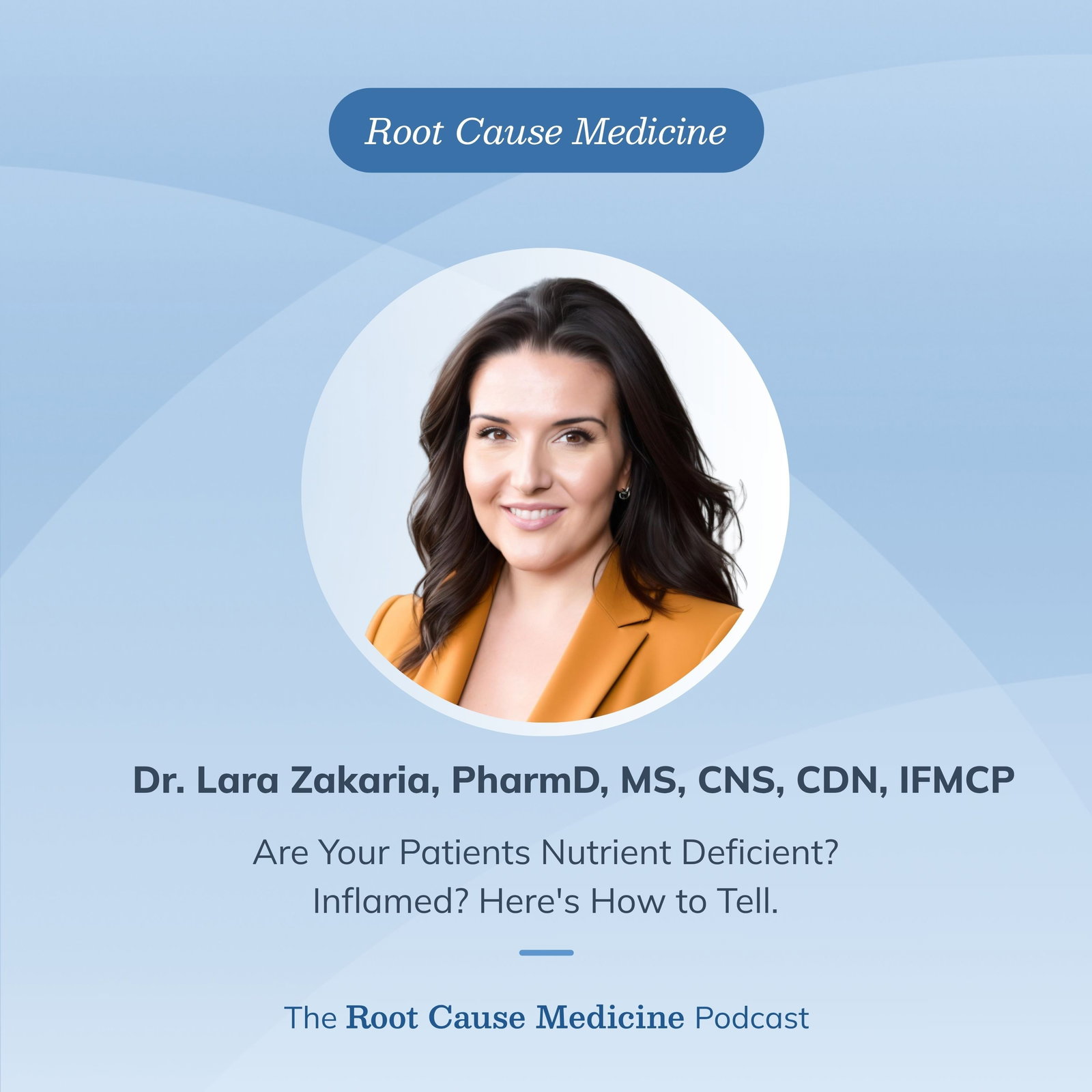
Dr. Lara Zakaria
Dr. Jessica Christie
Are Your Patients Nutrient Deficient? Inflamed? Here's How to Tell


There’s a category of patients every clinician recognizes immediately.
They’re exhausted.
Their hair is thinning.
They’re getting sick more often than they used to.
Their focus isn’t what it was.
And their labs?
“Normal.”
This episode is about what gets missed in that gap.
We sit down with Lara Zakaria the least commonly tested for (but most commonly occuring) nutrient deficiencies that can help to explain symptoms like fatigue, hair loss, impaired immune function, and reduced resilience.
We walk through how a structured nutrition panel combining familiar markers like CBC and iron studies with underutilized ones like vitamin B6, folate, zinc, and RBC magnesium can reveal patterns that standard interpretations often overlook.
Because the future isn’t more testing - it’s running the right labs and using smarter interpretation to uncover what’s been hiding in plain sight.
Clinical Takeaways from This Episode
- Pattern recognition is the clinical upgrade: Interpreting CBC, iron studies, and nutrient markers together - rather than in isolation - helps connect symptoms to physiology and identify contributing drivers earlier.
- Iron deficiency can exist before anemia: Hemoglobin is often a late marker; early depletion may only be visible through ferritin and iron transport patterns (Dhurde, 2025).
- Intracellular status matters: Serum values alone may miss functional deficiencies—markers like RBC magnesium offer insight into cellular availability and physiologic demand (Razzaque, 2018).
- Underutilized nutrients complete the picture: Vitamin B6 and zinc play roles in neurotransmitter pathways, immune signaling, and metabolic function—but are rarely assessed together in standard workflows.
Guest Introduction
Dr. Lara Zakaria is an integrative pharmacist, nutritionist, and professor specializing in Functional Medicine and Personalized Nutrition. In addition to clinical practice and teaching, her work focuses on translating complex science—spanning nutrition, natural products, diagnostics, and health technology—into clear, clinically relevant frameworks that support education, implementation, and informed decision-making. You can sign up for the Journeys webinar series with Dr. Zakaria here.
FAQ
- What types of symptoms should prompt nutrient testing? Fatigue, brain fog, hair loss, reduced exercise tolerance, and frequent illness are common presentations where nutrient patterns may play a role.
- Why isn’t hemoglobin enough to assess iron status? Hemoglobin changes occur later in the course of deficiency. Ferritin, transferrin saturation, and TIBC provide earlier insight into iron availability and storage (Dhurde, 2025).
- Why include markers like B6 and zinc? These nutrients are involved in neurotransmitter production, immune response, and metabolic pathways. They are often under-assessed but may contribute to overlapping symptom patterns.
- What’s the benefit of RBC magnesium vs serum magnesium? Serum magnesium reflects a small, tightly regulated portion of total body magnesium, while RBC magnesium offers a better proxy for intracellular status (Al Alawi, 2018).
Timestamps
- 02:36 – The new way to test for nutrient deficiencies
- 03:55 – Building a smarter, structured nutrition panel
- 10:54 – Vitamin D and why “adequate” isn’t always enough
- 17:34 – Iron deficiency and early clinical clues
- 24:43 – B vitamins and functional metabolism
- 30:53 – Zinc: the overlooked but essential nutrient
- 34:57 – Answering “Am I inflamed?” with data
- 43:31 – Fatty acids and inflammation patterns
- 48:33 – Making personalized care scalable and efficient
This episode is sponsored by Fullscript, a comprehensive care delivery platform designed to support whole-person, integrative healthcare. Fullscript allows clinicians to streamline supplement dispensing, lab ordering, and patient education in one free, centralized system—helping reduce administrative burden while supporting clinical decision-making. For practitioners, Fullscript offers access to professional-grade supplements, evidence-informed protocols, and lab integrations that can support more efficient planning and follow-up. For patients, it provides a clear, organized way to receive recommendations, manage refills, and stay engaged in their care. The goal is not to replace clinical judgment, but to make it easier for clinicians to focus on what matters most: thoughtful, individualized patient care.
Disclaimer
The views expressed on this podcast are those of the hosts and the guests, and they don’t necessarily reflect the views of Fullscript or any affiliated organizations. This podcast is for informational and educational purposes only, and it’s not intended to be medical advice. For your safety, always check with your healthcare provider before making any changes to your healthcare routine. We’ll catch you next time on the Root Cause Medicine Podcast.
Citations
- Dhurde VS, Patel AB, Locks LM, Hibberd PL. Diagnostic performance of red cell indices in detecting iron deficiency and iron deficiency anemia among rural adolescent girls aged 14-19 years in Nagpur District. PLOS Glob Public Health. 2025 Sep 29;5(9):e0005108. doi: 10.1371/journal.pgph.0005108. PMID: 41021630; PMCID: PMC12478879.
- Chaudhry, H. S., & Kasarla, M. R. (2026). Microcytic hypochromic anemia. StatPearls. Retrieved March 31, 2026 from https://www.ncbi.nlm.nih.gov/books/NBK470252/
- Razzaque MS. Magnesium: Are We Consuming Enough? Nutrients. 2018 Dec 2;10(12):1863. doi: 10.3390/nu10121863. PMID: 30513803; PMCID: PMC6316205.
- Al Alawi AM, Majoni SW, Falhammar H. Magnesium and Human Health: Perspectives and Research Directions. Int J Endocrinol. 2018 Apr 16;2018:9041694. doi: 10.1155/2018/9041694. PMID: 29849626; PMCID: PMC5926493.