
Hosted by
Dr. Carrie Jones
Dr. Kate Kresge
Dr. Holly Lucille
Dr. Lara Zakaria
Dr. Jessica Christie
Dr. Kate Kresge
Dr. Holly Lucille
Dr. Lara Zakaria
Dr. Jessica Christie
December 4, 2025
・
20
mins
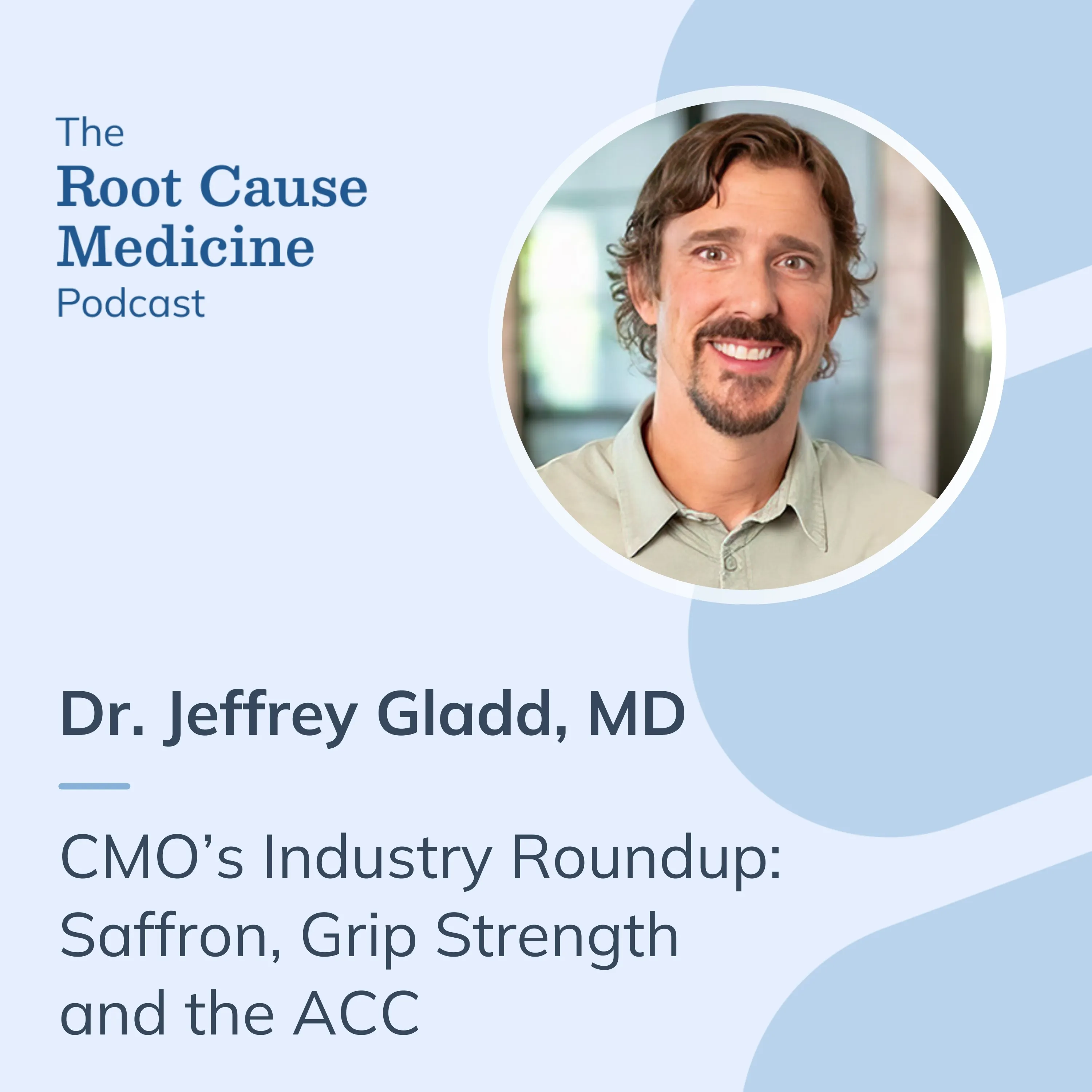
CMO’s Industry Roundup: Saffron, Grip Strength and the ACC


Transcription
See more

CMO’s Industry Roundup: Saffron, Grip Strength and the ACC
We’re launching a new series that brings the insights that Fullscript Chief Medical Officer Dr. Jeff Gladd normally shares only with our internal team—now open to the entire integrative and functional medicine community.
This month, Dr. Gladd breaks down three emerging clinical priorities with immediate relevance to whole-person care
- Why the American College of Cardiology is now recommending high-sensitivity CRP (hs-CRP) for universal cardiovascular screening
- How grip strength paired with BMI is outperforming traditional biomarkers in predicting metabolic decline and all-cause mortality risk
- What new evidence tells us about saffron as supportive care for patients experiencing SSRI-related sexual side effects.
Clinicians will leave with practical, evidence-informed strategies they can apply right away—from how to add grip strength testing to a routine visit, to how to interpret hs-CRP in the context of inflammation and cardiometabolic disease, to how to navigate sensitive conversations about mood medications and quality of life. If you’ve been looking for research you can trust and tools that simplify decision-making, this episode offers a clear roadmap.
Clinical Takeaways from This Episode
- Grip strength combined with BMI is emerging as a scalable, low-cost predictor of metabolic risk and all-cause mortality
- Dr. Gladd highlights the UK Biobank’s 90,000-person longitudinal analysis, noting: “Those in the highest grip strength tertile were 20% less likely to develop obesity-related disease,” with reduced all-cause mortality. Grip strength may reflect lean mass, mitochondrial function, and insulin sensitivity better than BMI alone.
- Grip strength as a lifestyle, bone health, and functional resilience indicator
- As Dr. Kresge explains, “having a strong grip can basically imply that you’re likely living a healthier life,” given its links to nutrient-dense dietary patterns, sufficient protein intake, sleep quality, smoking avoidance, and greater sense of purpose. Evidence also shows low grip strength strongly correlates with lower bone mineral density in postmenopausal women.
- Saffron may improve SSRI-associated sexual side effects
- RCTs suggest saffron may support sexual function parameters in individuals using SSRIs, with sex-specific benefits observed. As Dr. Gladd notes, “We haven’t had anything, to my knowledge, that really addresses the sexual side effects head-on like this study in saffron.” Findings support integration—not substitution—within existing mental health plans.
- Universal hs-CRP screening is now recommended for cardiovascular prevention
- The American College of Cardiology now recommends hs-CRP as part of routine cardiovascular risk screening—reflecting a shift toward evaluating systemic inflammation. Dr. Gladd emphasizes: “Inflammation is now in traditional healthcare as something that can be measured and understood.”
- Causes of elevated hs-CRP and how to evaluate them clinically
- Dr. Kresge outlines the major drivers to consider, including infection, autoimmune activity, periodontal disease, adiposity, insulin resistance, low fitness, smoking, poor sleep, chronic stress, and nutrition patterns. She notes: “It’s no longer enough to run a lipid panel and call it cardiovascular screening.”
- Dietary patterns, omega-3 fatty acids, and curcumin as inflammation-supportive strategies
- Inflammation-modulating strategies may include nutrient-dense dietary patterns, omega-3 intake providing approximately 1,000–2,000 mg EPA+DHA when appropriate, and high-bioavailability curcumin. Dr. Gladd encourages clinicians to verify product quality: “Are you getting enough EPA and DHA?”
- Nutrient monitoring opportunities for patients using SSRIs
- SSRIs may influence magnesium and B-vitamin status, and Dr. Gladd notes that clinicians may want to be “proactive in supplementing or monitoring those levels,” when appropriate for patient-centered mental health care.
- Ensuring AI is used to support—not replace—clinical judgment
- Dr. Gladd discusses emerging regulations to prevent AI from impersonating clinicians, underscoring Fullscript’s stance: “We’re bringing tooling to support the practitioner, not to replace the practitioner.”
- The persistence of clinician burnout and the need for operational support
- The 2025 Medscape Well-Being Report highlights burnout as an ongoing challenge. Streamlined clinical tools, thoughtful workflows, and comprehensive care platforms may help reduce administrative load.
Guest Introduction: Dr. Jeff Gladd, MD, Chief Medical Officer at Fullscript, is a nationally recognized integrative and lifestyle medicine physician. He founded GladdMD Integrative Medicine and authors Fullscript’s CMO Monthly Dose—a monthly research and industry briefing for keeping Fullscripters up to date. His work focuses on metabolic health, clinical nutrition, and technology that enhances clinical workflow. Learn more at fullscript.com.
Labs, Nutrition, and Lifestyle Support
High-sensitivity CRP (hs-CRP) testing for cardiovascular and inflammatory risk assessment
Key labs mentioned
- hs-CRP (per ACC universal screening recommendation)
- Lipid panel and triglycerides
- Fasting insulin or HOMA-IR
- CBC, ESR, ANA when clinically indicated
- Oral health evaluation for periodontal inflammation
Lifestyle and nutrition opportunities
- Moderate aerobic activity and resistance training
- Smoking cessation support
- Sleep optimization and stress-reduction strategies
- Mediterranean-style, anti-inflammatory dietary pattern
Grip strength assessment for metabolic health, muscle preservation, and functional longevity
How to assess
- Handheld dynamometer in-clinic or at-home
Factors associated with increased grip strength
- Progressive resistance training 2–3 times weekly
- Adequate protein intake (~1.0–1.2 g/kg/day depending on individual needs)
- High-quality dietary pattern rich in micronutrients (magnesium, vitamin D, folate, B12, omega-3s)
- Sufficient sleep and reduction of sedentary time
- Smoking cessation and cardiometabolic risk control
Saffron and nutrient monitoring in integrative mental health
Clinical context
- May support sexual function in individuals experiencing SSRI-related changes
- Did not diminish antidepressant benefits in trials
- Could be considered alongside mood evaluation, sleep quality, and therapeutic alliance
Safety considerations
- Avoid in pregnancy
- Use caution in bipolar disorder
- Choose standardized extracts studied in clinical trials
Nutrient monitoring
- Magnesium and B vitamins may warrant assessment in patients on SSRIs
- Support may be considered as part of whole-person mental health care
Summary
This episode gives clinicians a close look at the data shaping integrative care right now—and why these updates matter for the challenges you face daily in practice. Dr. Gladd explains what he calls “accessible tools that really track how well that patient’s doing,” giving clinicians strategies that fill real gaps: how to detect metabolic decline earlier, how to support patients on SSRIs without discontinuing helpful therapy, and how to improve cardiovascular risk assessment using inflammation science the ACC now recognizes as standard of care. You’ll hear how nearly 100,000-person UK Biobank data are reframing grip strength as a core metabolic biomarker; why saffron is becoming a promising option for patients struggling with SSRI-related quality-of-life concerns; and how hs-CRP offers a broader picture of cardiometabolic risk than lipids alone. This is a high-yield, high-clarity episode designed to help clinicians make better decisions, streamline assessment, and deepen whole-person care.
Disclaimer: The views expressed on this podcast are those of the hosts and guests and don’t necessarily reflect those of Fullscript or any affiliated organizations. This podcast is for informational and educational purposes only and is not intended to be medical advice. For your safety, always check with your doctor or healthcare provider before making changes to your health routine.
Citations
- Mensah, G, Arnold, N, Prabhu, S. et al. Inflammation and Cardiovascular Disease: 2025 ACC Scientific Statement: A Report of the American College of Cardiology. JACC. Published online Sept. 29, 2025. doi:10.1016/j.jacc.2025.08.047
- Xu, Mangrong et al. Handgrip Strength and Trajectories of Preclinical Obesity Progression: A Multistate Model Analysis Using the UK Biobank. J Clin Endocrinol Metab. 2025; https://academic.oup.com/jcem/advance-article/doi/10.1210/clinem/dgaf521/8277450
- Shafiee A, Jafarabady K, Seighali N, Mohammadi I, Rajai Firouz Abadi S, Abhari FS, Bakhtiyari M. Effect of Saffron Versus Selective Serotonin Reuptake Inhibitors (SSRIs) in Treatment of Depression and Anxiety: A Meta-analysis of Randomized Controlled Trials. Nutr Rev. 2025 Mar 1;83(3):e751-e761. doi: 10.1093/nutrit/nuae076. PMID: 38913392.
- Modabbernia A, Sohrabi H, Nasehi AA, Raisi F, Saroukhani S, Jamshidi A, Tabrizi M, Ashrafi M, Akhondzadeh S. Effect of saffron on fluoxetine-induced sexual impairment in men: randomized double-blind placebo-controlled trial. Psychopharmacology (Berl). 2012 Oct;223(4):381-8. doi: 10.1007/s00213-012-2729-6. Epub 2012 May 3. PMID: 22552758.
- Gedmantaite A, Celis-Morales CA, Ho F, Pell JP, Ratkevicius A, Gray SR. Associations between diet and handgrip strength: a cross-sectional study from UK Biobank. Mech Ageing Dev. 2020 Jul;189:111269. doi: 10.1016/j.mad.2020.111269. Epub 2020 May 30. PMID: 32479757.
- Li YZ, Zhuang HF, Cai SQ, Lin CK, Wang PW, Yan LS, Lin JK, Yu HM. Low Grip Strength is a Strong Risk Factor of Osteoporosis in Postmenopausal Women. Orthop Surg. 2018 Feb;10(1):17-22. doi: 10.1111/os.12360. Epub 2018 Feb 12. PMID: 29430846; PMCID: PMC6594500
- Sutin AR, Luchetti M, Stephan Y, Mansor N, Kekäläinen T, Terracciano A. Purpose in life and grip strength: An individual-participant meta-analysis of 115,972 participants from 24 countries across four continents. Geroscience.
Related Lab Tests
No items found.
Episode Highlights
No items found.
Recent Episodes