
Hosted by
Dr. Carrie Jones
Dr. Kate Kresge
Dr. Holly Lucille
Dr. Lara Zakaria
Dr. Jessica Christie
Dr. Kate Kresge
Dr. Holly Lucille
Dr. Lara Zakaria
Dr. Jessica Christie
March 19, 2026
・
15
mins
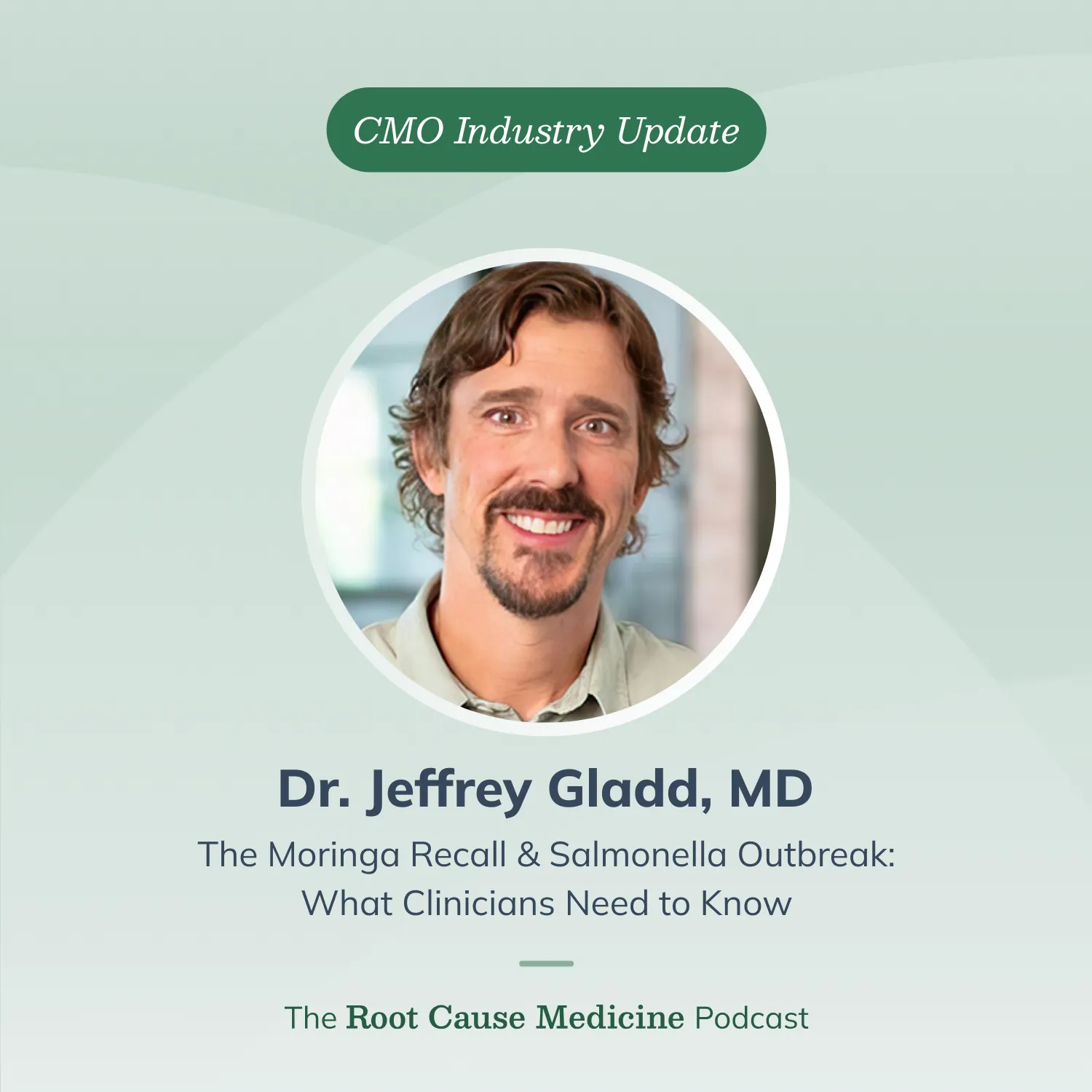
The Moringa Recall & Salmonella Outbreak: What Clinicians Need to Know


Transcription
See more

Are your patients putting Salmonella in their morning smoothie?
That’s essentially what happened recently when people added what they believed was a safe, antioxidant-packed greens powder to their daily routine.
The ingredient? Moringa.
Moringa leaf powder is often marketed as a nutrient-dense botanical containing vitamins, minerals, antioxidants, and plant compounds that may support general wellness (Bibi et al., 2024; Camilleri & Blundell, 2024). For many people, it feels like an easy health habit: add a scoop to a smoothie and start the day feeling proactive about nutrition.
But recently, moringa powder was linked to Salmonella infections that resulted in hospitalizations.
So what happened?
In this episode, Jeff and I walk through how contamination can occur and how practitioners can protect their patients from a similar fate.
This story ultimately isn’t about moringa.
It’s about why manufacturing quality and supply chain oversight are critical when evaluating dietary supplements.
Clinical Takeaways from This Episode
- Botanical powders can carry microbial risk if supply chain controls fail
- Plant-derived supplements are grown in open agricultural environments where contamination from soil, water, or wildlife can occur. Without appropriate processing and testing, pathogens such as Salmonella may persist (Lin et al., 2024).
- Salmonella can survive in dry foods for long periods
- Low-moisture products—including spices, flour, and powdered botanicals—can allow Salmonella to remain viable for extended periods despite appearing shelf-stable (Lin et al., 2024; Flock et al., 2022).
- Manufacturing standards are a key safeguard in supplement safety
- Systems such as supplier verification, microbial testing, pathogen-reduction steps, and lot traceability—required under Current Good Manufacturing Practices (cGMP)—are designed to reduce contamination risk in dietary supplements (Bailey, 2020; Ma et al., 2025).
Guest Introduction: Jeff Gladd, MD is the Chief Medical Officer at Fullscript, where he helps guide clinical strategy and stays current on emerging research, safety developments, and regulatory changes across the supplement and integrative health industries. In this role, he reviews scientific evidence, manufacturing practices, and industry trends to support clinicians using professional-grade supplement solutions. Dr. Gladd is also a practicing physician at GladdMD, where he focuses on integrative and functional approaches to patient care. His work bridges clinical medicine, nutritional science, and supplement safety—helping clinicians evaluate dietary supplements within everyday practice.
Clinician FAQ
- Is Salmonella infection from supplements common?
- Salmonella is one of the most common causes of foodborne illness globally, though infections linked to dietary supplements are relatively uncommon compared with traditional foods (Shane et al., 2017). However, outbreaks involving powdered foods and botanical ingredients have been documented.
- What symptoms should clinicians watch for?
- Symptoms typically begin 6 hours to 3 days after exposure and may include diarrhea, abdominal cramps, fever, nausea, and vomiting (Eikmeier et al., 2018; Butt et al., 2004). Most healthy adults recover within several days without antibiotics
- How can clinicians help patients choose safer supplements?
- Encourage patients to choose products from manufacturers that follow Current Good Manufacturing Practices (cGMP), perform microbial testing, and maintain transparent sourcing and quality control systems (Bailey, 2020).
Episode Sponsor: This episode is sponsored by Fullscript, a comprehensive care delivery platform designed to support whole-person, integrative healthcare. Fullscript allows clinicians to streamline supplement dispensing, lab ordering, and patient education in one free, centralized system—helping reduce administrative burden while supporting clinical decision-making. For practitioners, Fullscript offers access to professional-grade supplements, evidence-informed protocols, and lab integrations that can support more efficient planning and follow-up. For patients, it provides a clear, organized way to receive recommendations, manage refills, and stay engaged in their care. The goal is not to replace clinical judgment, but to make it easier for clinicians to focus on what matters most: thoughtful, individualized patient care.
Disclaimer: The views expressed on this podcast are those of the hosts and guests and don’t necessarily reflect those of Fullscript or any affiliated organizations. This podcast is for informational and educational purposes only and is not intended to be medical advice. For your safety, always check with your doctor or healthcare provider before making changes to your health routine.
References
- Bibi N, Rahman N, Ali MQ, Ahmad N, Sarwar F. Nutritional value and therapeutic potential of Moringa oleifera: a short overview of current research. Nat Prod Res. 2024;38(23):4261-4279. doi:10.1080/14786419.2023.2284862
- Camilleri E, Blundell R. A comprehensive review of the phytochemicals, health benefits, pharmacological safety and medicinal prospects of Moringa oleifera. Heliyon. 2024;10(6):e27807. doi:10.1016/j.heliyon.2024.e27807
- Lin Z, Jiang S, Zwe YH, Zhang K, Li D. Glycogen plays a key role in survival of Salmonella Typhimurium on dry surfaces and in low-moisture foods. Food Res Int. 2024;175:113714. doi:10.1016/j.foodres.2023.113714
- Flock G, Richardson M, Pacitto-Reilly D, et al. Survival of Salmonella enterica in military low-moisture food products during long-term storage at 4, 25, and 40°C. J Food Prot. 2022;85(4):544-552. doi:10.4315/JFP-21-321
- Bailey RL. Current regulatory guidelines and resources to support research of dietary supplements in the United States. Crit Rev Food Sci Nutr. 2020;60(2):298-309. doi:10.1080/10408398.2018.1524364
- Ma C, Monagas M, Bronstein L, Cadwallader A, Goldman V. Dietary supplement adulteration: laboratory approaches to risk mitigation. J Nat Prod. 2025. doi:10.1021/acs.jnatprod.5c00456
- Shane AL, Mody RK, Crump JA, et al. 2017 Infectious Diseases Society of America clinical practice guidelines for the diagnosis and management of infectious diarrhea. Clin Infect Dis. 2017;65(12):e45-e80. doi:10.1093/cid/cix669
- Eikmeier D, Medus C, Smith K. Incubation period for outbreak-associated, non-typhoidal salmonellosis cases, Minnesota, 2000–2015. Epidemiol Infect. 2018;146(4):423-429. doi:10.1017/S0950268818000079
- Butt AA, Aldridge KE, Sanders CV. Infections related to the ingestion of seafood: part I—viral and bacterial infections. Lancet Infect Dis. 2004;4(4):201-212. doi:10.1016/S1473-3099(04)00969-7
- Marchello CS, Birkhold M, Crump JA; Vacc-iNTS Consortium Collaborators. Complications and mortality of non-typhoidal Salmonella invasive disease: a global systematic review and meta-analysis. Lancet Infect Dis. 2022;22(5):692-705. doi:10.1016/S1473-3099(21)00615-0
- Falowo AB, Mukumbo FE, Idamokoro EM, et al. Multi-functional application of Moringa oleifera Lam. in nutrition and animal food products: a review. Food Res Int. 2018;106:317-334. doi:10.1016/j.foodres.2017.12.079
- Fernandes Â, Bancessi A, Pinela J, et al. Nutritional and phytochemical profiles and biological activities of Moringa oleifera Lam. edible parts from Guinea-Bissau (West Africa). Food Chem. 2021;341(pt 1):128229. doi:10.1016/j.foodchem.2020.128229
- Hassan MA, Xu T, Tian Y, et al. Health benefits and phenolic compounds of Moringa oleifera leaves: a comprehensive review. Phytomedicine. 2021;93:153771. doi:10.1016/j.phymed.2021.153771
- Ramesh B, Chauhan R, Don PMU, et al. Moringa oleifera: a comprehensive review of its nutritional benefits, functional applications, and future potential in food science. J Sci Food Agric. 2025. doi:10.1002/jsfa.7038
Related Lab Tests
No items found.
Episode Highlights
No items found.
Recent Episodes